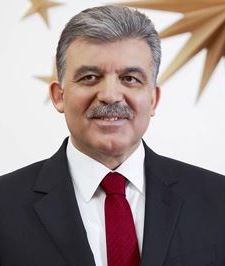
Abdullah Gül
Turkish politician who was Prime Minister in 2002-03 and President of Turkey from 2007 to 2014.
Biography
Abdullah Gül was born in Kayseri in 1950. He studied economics at Istanbul University, spent time in Britain at the University of Exeter, and taught industrial engineering at Sakarya University while writing a doctorate on Turkey's economic ties with Muslim countries, awarded by Istanbul University in 1983. From 1983 to 1991 he worked at the Islamic Development Bank.
Elected to parliament for Kayseri in 1991 for the Islamist Welfare Party, he was a minister of state in Necmettin Erbakan's government in 1996-97. After the Welfare Party was banned he joined the Virtue Party, and when it split he sided with the reformist wing; with Recep Tayyip Erdoğan he co-founded the Justice and Development Party (AKP) in 2001.
The AKP won the 2002 election while Erdoğan was barred from office, so Gül became prime minister until Erdoğan could take over in March 2003. He then served as foreign minister and deputy prime minister until 2007. His nomination for the presidency that year met strong secularist opposition and was first blocked by the Constitutional Court, but parliament elected him in August 2007, the first Turkish president from a political Islamist background.
As president until 2014 he signed several contested laws, but he took a conciliatory line during the 2013 Gezi Park protests. He has since been an independent.
Offices held
Bülent Ecevit Succeeded by
Recep Tayyip Erdoğan
Ahmet Necdet Sezer Succeeded by
Recep Tayyip Erdoğan
Affiliations
Employment
- Jan 1, 1983 – Jan 1, 1991 Islamic Development Bank
Party membership
- Jan 1, 1991 – Jan 1, 1998 Welfare Party
- Jan 1, 1998 – Jan 1, 2001 Virtue Party
- Justice and Development Party
Education
- Istanbul University economics; PhD 1983
- University of Exeter
- University of London

