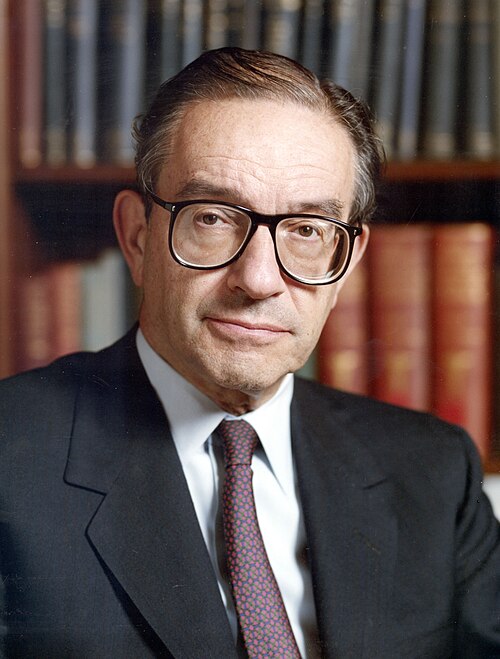
Alan Greenspan
American economist who chaired the Federal Reserve from 1987 to 2006.
Biography
Alan Greenspan was born in New York City in 1926 and grew up in Washington Heights. A clarinettist and saxophonist, he studied clarinet at the Juilliard School and played in a swing band before turning to economics at New York University, where he took a bachelor's degree in 1948 and a master's in 1950. He began doctoral studies at Columbia University under Arthur Burns but left them for his consulting work, and completed an NYU doctorate only in 1977.
From 1948 to 1953 Greenspan was an analyst at the National Industrial Conference Board, and from 1955 to 1987 he ran the economic consultancy Townsend-Greenspan & Co. in New York. He advised Richard Nixon's 1968 campaign, chaired President Gerald Ford's Council of Economic Advisers from 1974 to 1977, and in 1981-1983 chaired the commission on Social Security reform that bears his name.
Ronald Reagan appointed him chairman of the Federal Reserve in 1987, and he was reappointed by three further presidents, serving until January 2006. Weeks after taking office he steered the Fed's response to the October 1987 stock market crash, and he later helped organise the US rescue during the Mexican peso crisis. Admired in the 1990s, he was later blamed by many economists for easy-money policies that fed the dot-com and housing bubbles. After leaving the Fed he ran the consultancy Greenspan Associates. He died in Washington in June 2026 at the age of 100.
Affiliations
Education
- Jan 1, 1943 – Jan 1, 1944 Juilliard School studied clarinet
- Jan 1, 1945 – Jan 1, 1950 New York University BA (1948) and MA (1950) in economics; PhD 1977
- Columbia University graduate studies under Arthur Burns, not completed
Employment
- Jan 1, 1948 – Jan 1, 1953 The Conference Board analyst at the National Industrial Conference Board

