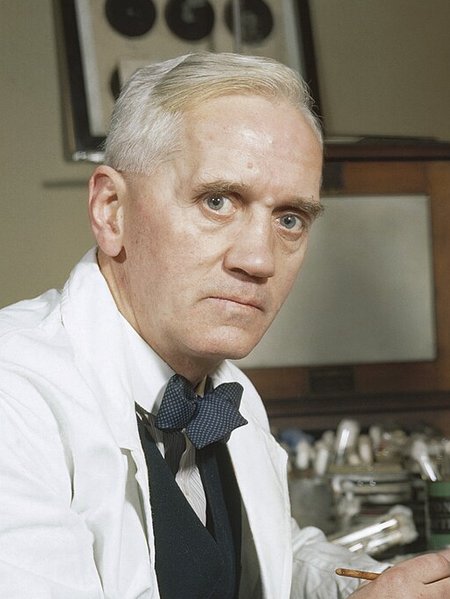
Alexander Fleming
August 6, 1881 – March 11, 1955
Scottish bacteriologist who discovered penicillin in 1928, the start of the antibiotic era.
Biography
Alexander Fleming was born in 1881 on Lochfield farm near Darvel in Ayrshire, Scotland. After Kilmarnock Academy he moved to London, attended the Royal Polytechnic Institution, and studied medicine at St Mary's Hospital Medical School, qualifying with distinction in 1906. He stayed at St Mary's in the research department of Sir Almroth Wright, a pioneer of vaccine therapy.
In the First World War he served as an officer in the Royal Army Medical Corps in France. Seeing soldiers die of infected wounds, he showed that the antiseptics then in use often did more harm than good. Back at St Mary's after the war, he discovered the antibacterial enzyme lysozyme in 1922.
In 1928 he noticed that a mould, later identified as a Penicillium, had killed the bacteria around it on a culture plate, and named the active substance penicillin. That year he was elected professor of bacteriology of the University of London. He could not purify the substance himself; Howard Florey and Ernst Chain's team at Oxford later turned it into a usable drug, and its mass production during the Second World War began the antibiotic era.
Fleming was knighted in 1944 and shared the 1945 Nobel Prize in Physiology or Medicine with Florey and Chain. He warned early that bacteria could become resistant to penicillin if it was misused. He died in London in 1955 and is buried in St Paul's Cathedral.
Affiliations
Employment
- from Jan 1, 1906 St Mary's Hospital Medical School research department (inoculation department) under Almroth Wright
- University of London
Education
- St Mary's Hospital Medical School
- Imperial College London
- Imperial College School of Medicine
- University of Westminster

