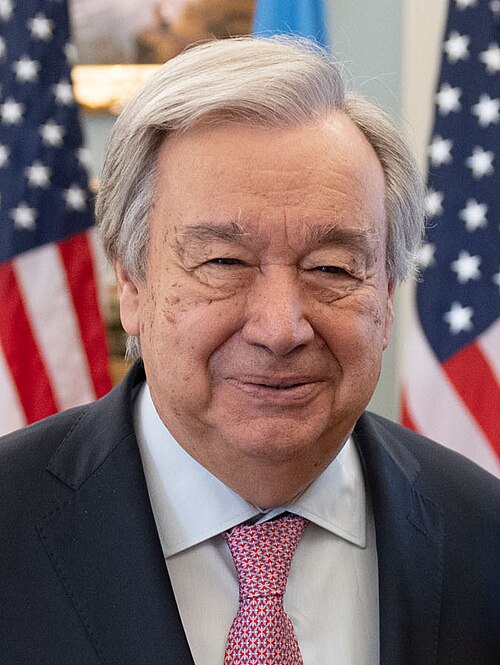
António Guterres
Portuguese politician who was Prime Minister of Portugal from 1995 to 2002, UN High Commissioner for Refugees and, from 2017, UN Secretary-General.
Biography
António Guterres was born in Lisbon in 1949. He studied physics and electrical engineering at the Instituto Superior Técnico, graduating in 1971, and briefly taught there as an assistant professor. As a student he was active in a Catholic youth group, the Grupo da Luz.
He joined the Socialist Party in 1974, soon after the Carnation Revolution, and left academic life for politics, representing Castelo Branco in the Assembly of the Republic from 1976 to 2002. In 1992 he became the party's secretary-general and leader of the opposition. The Socialists won the 1995 election and he became prime minister, winning again in 1999; his governments worked to meet the criteria for the euro and introduced a guaranteed minimum income. After heavy losses in the 2001 local elections he resigned as party leader, and he left office in April 2002.
Guterres was president of the Socialist International from 1999 to 2005 and then United Nations High Commissioner for Refugees from 2005 to 2015, where he reformed the agency during several large refugee crises. In October 2016 the UN chose him as its ninth Secretary-General, the first European in the post since Kurt Waldheim, and he took office on 1 January 2017.
Offices held
Aníbal Cavaco Silva Succeeded by
José Manuel Barroso
Affiliations
Employment
- from Jan 1, 1971 Instituto Superior Técnico Assistant professor of systems theory and telecommunications, before entering politics
Party membership
- from Jan 1, 1974 Socialist Party (Portugal)
Education
- Instituto Superior Técnico Physics and electrical engineering; graduated 1971
