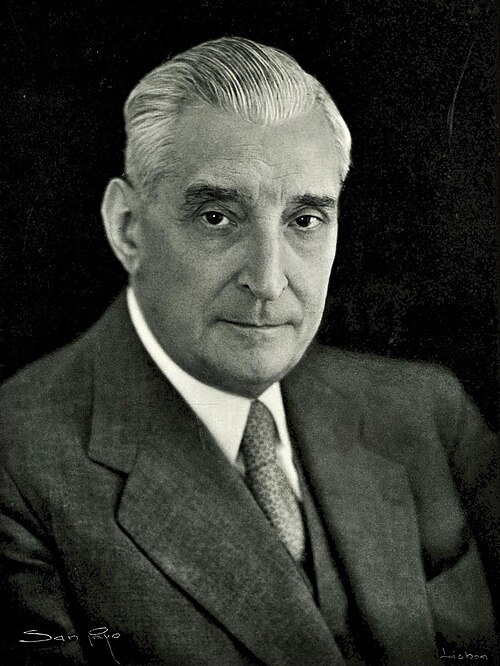
António de Oliveira Salazar
April 28, 1889 – July 27, 1970
Portuguese economist who ruled Portugal as dictator from 1932 to 1968 under the Estado Novo regime.
Biography
António de Oliveira Salazar was born in 1889 in Vimieiro, near Santa Comba Dão, the only son of a farm manager. He spent eight years at the seminary in Viseu but chose not to become a priest, and in 1910 went to the University of Coimbra to study law, specialising in finance. He became an assistant in economic policy, took the chairs of economic policy and finance in 1917, and received his doctorate the following year. He was briefly elected to parliament for the Portuguese Catholic Centre in 1921.
After the military coup of 28 May 1926, Salazar served a few days as finance minister in 1926 and returned to the post in 1928 with sweeping powers over the budget, which he quickly balanced. He became prime minister in 1932 and, through the 1933 constitution approved by referendum, built the corporatist Estado Novo, ruling as dictator with censorship and the PIDE secret police. At various times he also held the war, foreign affairs and defence portfolios himself.
Salazar backed Franco in the Spanish Civil War, kept Portugal neutral in the Second World War, and negotiated the 1940 concordat with the Holy See. Portugal under his rule was a founding member of NATO and EFTA and joined the United Nations in 1955. From 1961 he fought independence movements in Angola, Guinea and Mozambique and lost Goa to India. Incapacitated in 1968, he was replaced by Marcelo Caetano and died in Lisbon in 1970; his regime fell in the Carnation Revolution of 1974.
Offices held
Domingos Oliveira Succeeded by
Marcelo Caetano
Óscar Carmona Succeeded by
Francisco Craveiro Lopes
Affiliations
Party membership
- Jan 1, 1919 – Jan 1, 1930 Portuguese Catholic Centre
- National Union (Portugal)


