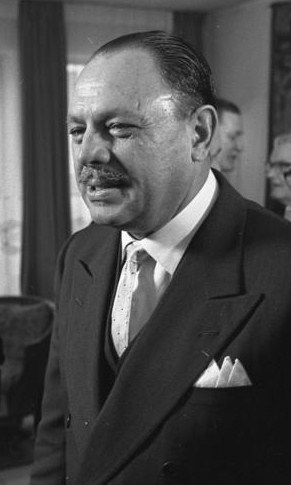
Ayub Khan
Pakistani field marshal who took power in 1958 and ruled Pakistan as President until he resigned in 1969.
Biography
Mohammad Ayub Khan was born in 1907 in a village in the Haripur district of the North-West Frontier Province of British India, the son of a cavalry non-commissioned officer. He studied at Aligarh Muslim University, entered the Royal Military College, Sandhurst, in 1926 and was commissioned in 1928, joining the 1/14th Punjab Regiment of the British Indian Army. In the Second World War he served in the Burma campaign, and by 1947 he was a brigadier on the North-West Frontier.
After partition he opted for Pakistan, commanded a division in East Bengal and became adjutant general. In January 1951 he was promoted over more senior officers to become the first native commander-in-chief of the Pakistan Army. He joined the cabinet as defence minister in 1954, signed Pakistan up to the CENTO alliance and backed the One Unit scheme that merged the western provinces into West Pakistan.
When President Iskander Mirza abrogated the constitution on 7 October 1958 he made Ayub chief martial law administrator; on 27 October Ayub removed Mirza and took the presidency himself. He ruled through a system of indirectly elected Basic Democrats, confirmed by a 1960 referendum, and issued a new constitution in 1962. His government pursued industrialization and private investment, built dams such as Mangla, issued the Muslim Family Laws Ordinance in 1961 and signed the Indus Waters Treaty with India in 1960, while aligning Pakistan with the United States.
He won a disputed 1965 presidential election against Fatima Jinnah. That year he authorized Operation Gibraltar in Kashmir, which led to war with India, ended by the Tashkent Declaration. Opposition led by Zulfikar Ali Bhutto and Sheikh Mujibur Rahman, strikes and the 1969 uprising in East Pakistan forced him to resign on 25 March 1969, handing power to General Yahya Khan. He died of a heart attack near Islamabad in 1974.
Offices held
Huseyn Shaheed Suhrawardy Succeeded by
Nurul Amin
Iskandar Ali Mirza Succeeded by
Maulvi Tamizuddin Khan
Military service
Affiliations
Education
- Jan 1, 1926 – Feb 2, 1928 Royal Military Academy Sandhurst Royal Military College, Sandhurst (predecessor of entity 3406); admitted 1926 (year), commissioned 2 February 1928
- Command and Staff College Quetta
- Aligarh Muslim University Studied there before Sandhurst; no dates in the article
Party membership
- Pakistan Muslim League
- Convention Muslim League Infobox party; its candidate in 1965; the CML article lists Ayub as its second president


