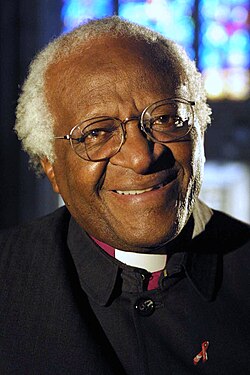
Desmond Tutu
October 7, 1931 – December 26, 2021
South African Anglican archbishop and anti-apartheid leader who later chaired the Truth and Reconciliation Commission; Nobel Peace Prize 1984.
Biography
Desmond Tutu was born in Klerksdorp in 1931 to a poor family of Xhosa and Motswana descent. Unable to afford medical school, he trained as a teacher at Pretoria Bantu Normal College and taught English and history until the Bantu Education Act led him to leave teaching. He studied at St Peter's Theological College, was ordained an Anglican priest in 1960, and took degrees in theology at King's College London in the 1960s.
Back in southern Africa he taught at the Federal Theological Seminary and in Lesotho, then directed the Theological Education Fund's work in Africa from London. Returning in 1975 as dean of St Mary's Cathedral in Johannesburg, he became Bishop of Lesotho in 1976 and in 1978 the first black general secretary of the South African Council of Churches, from where he became a leading voice against apartheid, urging non-violent protest and foreign economic pressure.
He received the Nobel Peace Prize in 1984, and became Bishop of Johannesburg in 1985 and Archbishop of Cape Town in 1986, in both cases the first black African in the post. After apartheid's end Nelson Mandela appointed him to chair the Truth and Reconciliation Commission, which began hearings in 1996.
In retirement he campaigned on gay rights, climate and other causes, criticised later ANC presidents and Israeli policy, and chaired The Elders from 2007 to 2013. He died in Cape Town in December 2021.
Affiliations
Education
- from Jan 1, 1951 Pretoria Bantu Normal College Teacher training
- Jan 1, 1956 – Jan 1, 1960 St Peter's Theological College Licentiate of Theology
- Jan 1, 1962 – Jan 1, 1966 King's College London
- University of South Africa
- Bates College
- Hamilton College
Employment
- Jan 1, 1967 – Jan 1, 1970 Federal Theological Seminary of Southern Africa Lecturer
- National University of Lesotho
