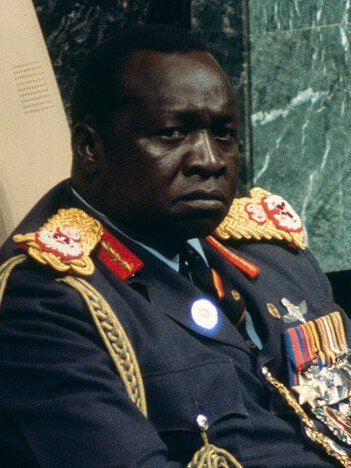
Idi Amin
January 1, 1925 – August 16, 2003
Ugandan army officer who seized power in 1971 and ruled Uganda as a brutal dictator until 1979.
Biography
Idi Amin was born to a Kakwa father and a Lugbara mother; British records give 1925 as his birth year, while his family and his Saudi death certificate give 30 May 1928. He joined the King's African Rifles of the British colonial army as a cook in 1946 and rose to lieutenant, taking part in operations against Somali rebels and in the Mau Mau Uprising in Kenya. After Uganda's independence in 1962 he stayed in the army, becoming deputy commander in 1964 and commander in 1966.
Learning that President Milton Obote planned to arrest him for misusing army funds, Amin seized power in a coup in January 1971 and declared himself president. His regime was marked by severe human rights abuses, economic mismanagement and corruption; estimates of the people killed range from 100,000 to 500,000. In August 1972 he ordered the expulsion of Uganda's Asian minority, most of them of Indian origin. He moved from pro-Western positions to alignment with Libya, the Soviet Union and East Germany, and in 1975 he took the rotating chairmanship of the Organisation of African Unity.
His support for the 1976 hijacking that ended in Israel's raid on Entebbe further isolated Uganda. In 1978 he tried to annex Tanzania's Kagera Region; Tanzania counter-attacked with Ugandan rebels and captured Kampala in April 1979, ending his rule. Amin went into exile in Libya, then Iraq and finally Saudi Arabia, and died in Jeddah in August 2003.
Offices held
Military service
- Jan 1, 1946 – Jan 1, 1962 British Army


