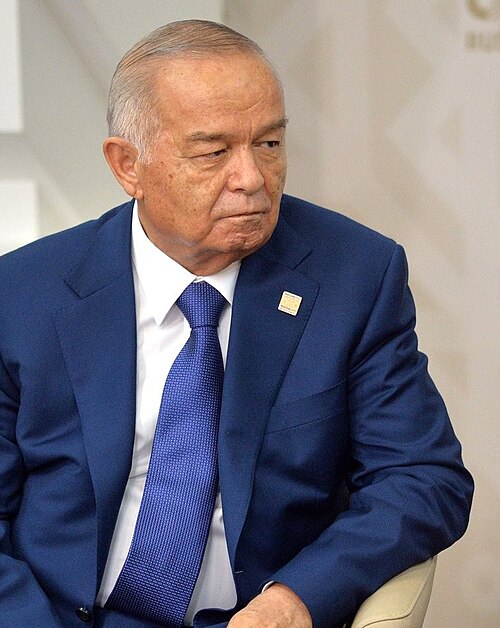
Islam Karimov
January 30, 1938 – September 2, 2016
Uzbek Communist leader who was the first President of Uzbekistan, from 1991 until his death in 2016.
Biography
Islam Karimov was born in Samarkand in 1938 and spent parts of his childhood in an orphanage. He graduated in mechanical engineering from the Central Asian Polytechnic Institute in Tashkent in 1960 and later took a master's degree in economics. After starting out as an engineer he joined the Uzbek state planning committee, where from 1966 he rose to become finance minister, chairman of the committee and deputy head of the republic's government.
In 1986 he became party chief of Kashkadarya region, and in June 1989 First Secretary of the Communist Party of Uzbekistan, after his predecessor failed to stop ethnic violence in the Fergana Valley. The Uzbek Supreme Soviet elected him president of the republic in March 1990. He declared Uzbekistan independent on 31 August 1991, turned the Communist Party into the People's Democratic Party, and won the presidential election of December 1991.
Karimov ruled independent Uzbekistan until his death. He extended his first term by referendum in 1995 and won further elections in 2000, 2007 and 2015 that foreign observers did not regard as free or fair. His government barred unregistered parties, jailed thousands of people as Islamist extremists and was found by the UN to use torture systematically; in 2005 security forces killed protesters in Andijan. He allowed US forces to use an Uzbek base after 2001, but moved closer to Russia and China after Western condemnation of Andijan.
He suffered a brain haemorrhage at the end of August 2016 and died in Tashkent on 2 September 2016.
Offices held
Affiliations
Party membership
- Nov 1, 1991 – Jan 1, 2007 People's Democratic Party of Uzbekistan
- Jan 1, 2007 – Sep 2, 2016 Uzbekistan Liberal Democratic Party infobox: Liberal Democratic (2007-2016); nominated by it in November 2007
- Communist Party of the Soviet Union
- Self-Sacrifice National Democratic Party
Education
- Tashkent State Technical University then the Central Asian Polytechnic Institute; mechanical engineering
- Tashkent State University of Economics master's degree in economics


