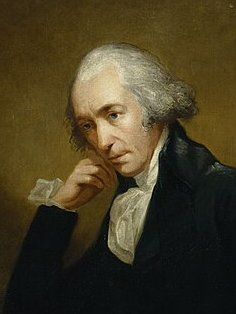
James Watt
January 19, 1736 – August 25, 1819
Scottish engineer whose improved steam engine powered the Industrial Revolution.
Biography
James Watt trained as an instrument maker in Glasgow and London and worked at the University of Glasgow. In 1765, while repairing a model Newcomen engine, he conceived a separate condenser, which made steam engines far more efficient.
From 1775 he went into partnership with the Birmingham manufacturer Matthew Boulton. Boulton and Watt engines were first used to pump water from mines and, after Watt added rotary motion and other improvements, to drive factory machinery.
His engines were central to the Industrial Revolution. He also coined the term horsepower, and the SI unit of power, the watt, is named after him. He died in 1819.
Affiliations
Employment
- from Jan 1, 1757 University of Glasgow Mathematical instrument maker with a workshop inside the university
- Jan 1, 1775 – Jan 1, 1800 Boulton and Watt partner with Matthew Boulton
