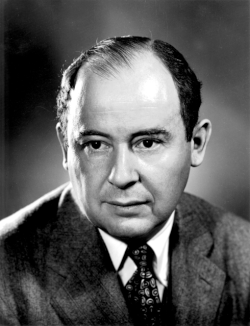
John von Neumann
December 28, 1903 – February 8, 1957
Hungarian-American mathematician who shaped game theory, the stored-program computer design and the Manhattan Project.
Biography
John von Neumann was born in Budapest in 1903. At his father's wish he combined a chemistry course in Berlin and a chemical engineering degree at ETH Zurich with a doctorate in mathematics from the University of Budapest, finishing both in 1926, and then studied under David Hilbert at Gottingen.
He lectured as a Privatdozent in Berlin from 1928 and briefly in Hamburg before moving to Princeton in 1929 and to a professorship at the Institute for Advanced Study in 1933; he became a US citizen in 1937. His work ranged from set theory and the mathematical foundations of quantum mechanics to operator algebras, ergodic theory and the minimax theorem that founded game theory.
An expert on explosions, he joined the Manhattan Project, where he worked out the explosive lenses for the implosion bomb, and he watched the Trinity test in 1945. After the war he consulted widely for the military, pushed the hydrogen bomb and chaired committees that set the course of the US intercontinental missile programme. In computing he wrote the EDVAC report describing the stored-program design and built the IAS machine at Princeton.
Appointed to the Atomic Energy Commission in 1955, he was already ill with cancer and died in Washington in February 1957, aged 53.
Affiliations
Education
- Jan 1, 1921 – Jan 1, 1923 Humboldt University of Berlin Two-year non-degree chemistry course at the University of Berlin
- Jan 1, 1923 – Jan 1, 1925 ETH Zurich
- Jan 1, 1926 – Jan 1, 1927 University of Göttingen
- Jan 1, 1926 – Jan 1, 1926 Eötvös Loránd University
Employment
- Jan 1, 1928 – Jan 1, 1929 Humboldt University of Berlin Privatdozent at the University of Berlin
- Jan 1, 1929 – Jan 1, 1930 University of Hamburg
- Jan 1, 1930 – Jan 1, 1933 Princeton University
- Jan 1, 1933 – Jan 1, 1957 Institute for Advanced Study
- Jan 1, 1940 – Jan 1, 1941 Ballistic Research Laboratory
- Jan 1, 1943 – Jan 1, 1955 Los Alamos National Laboratory

