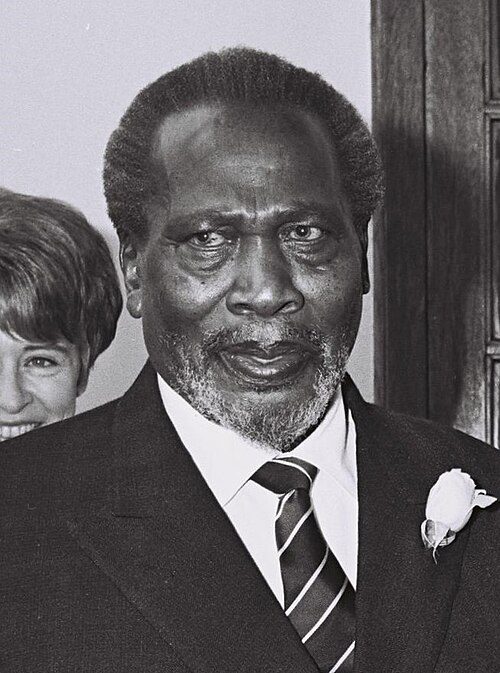
Jomo Kenyatta
Kenyan anti-colonial leader who was jailed by the British during the Mau Mau Uprising. He became Kenya's first Prime Minister and then President (1964-1978).
Biography
Jomo Kenyatta was born Kamau to Kikuyu farmers in central Kenya, probably in the 1890s; his exact birth date was never recorded. Educated at a Church of Scotland mission, he worked in Nairobi and became active in the Kikuyu Central Association, which sent him to London in 1929 to argue Kikuyu land grievances.
During the 1930s he studied in Moscow at the Communist University of the Toilers of the East and in London at University College London and the London School of Economics, where he wrote the anthropological study Facing Mount Kenya (1938). He spent the Second World War in England and helped organise the 1945 Pan-African Congress in Manchester.
Back in Kenya, he was elected president of the Kenya African Union in 1947. In 1952 the colonial authorities arrested him as one of the Kapenguria Six, accused of directing the Mau Mau uprising; convicted despite maintaining his innocence, he was imprisoned and then held in internal exile until 1961.
On release he led the Kenya African National Union to victory in the 1963 election, became prime minister and, after Kenya became a republic in 1964, its first president. His rule promoted reconciliation with the settler minority and a pro-Western, capitalist course, but also became increasingly authoritarian, with a de facto one-party state. He died in office in 1978.
Offices held
Affiliations
Education
- from Jan 1, 1932 Communist University of the Toilers of the East studied in Moscow from late 1932
- Jan 1, 1935 – Jun 30, 1936 University College London English course Jan-Jul 1935, phonetics course Oct 1935-Jun 1936
- London School of Economics social anthropology under Malinowski, mid-1930s; no exact dates in source
Party membership
- Oct 1, 1961 – Aug 22, 1978 Kenya African National Union
Family
Jomo Kenyatta