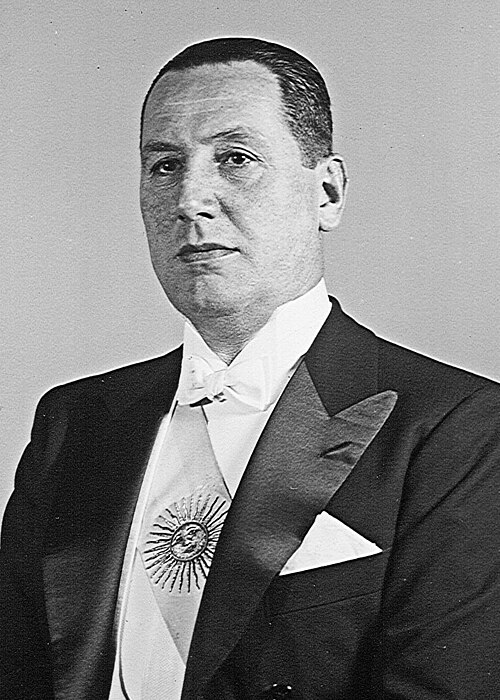
Juan Perón
October 8, 1895 – July 1, 1974
Argentine army officer and President of Argentina (1946-1955 and 1973-1974) whose populist movement, Peronism, has shaped Argentine politics since.
Biography
Juan Perón was born in Lobos, Buenos Aires Province, in 1895 and entered the military college in 1911. He rose through the army, studied mountain warfare in Italy in 1939 and served as a military attaché in Rome and Berlin, and as a colonel took a leading part in the 1943 coup staged by the United Officers' Group. Under the military government he was secretary of labour, minister of war and vice president, and won broad union support with labour reforms.
Forced to resign and arrested in October 1945, he was freed after a mass demonstration in the Plaza de Mayo on 17 October and won the February 1946 presidential election as the Labour Party candidate. With his wife Eva Duarte he expanded social rights, promoted industry, made university tuition free and extended the vote to women, building the movement known as Peronism; his government also purged opponents and controlled the press. He was re-elected in 1951.
A conflict with the Catholic Church led to the bombing of the Plaza de Mayo by rebel forces in June 1955 and to a coup in September that sent him into exile in Paraguay, Venezuela, Panama and Spain. He returned in June 1973 amid the Ezeiza massacre, was elected president for a third time, and died in office on 1 July 1974, succeeded by his wife and vice president Isabel Perón.
Offices held
Edelmiro Julián Farrell Succeeded by
Isabel Martínez de Perón
2 terms
- Jun 4, 1946 – Sep 21, 1955 Preceded by Edelmiro Julián Farrell Succeeded by José Domingo Molina Gómez
- Oct 12, 1973 – Jul 1, 1974 Preceded by Raúl Alberto Lastiri Succeeded by Isabel Martínez de Perón
Military service
Affiliations
Education
- from Jan 1, 1911 Colegio Militar de la Nación
Party membership
- Jan 1, 1945 – Jan 1, 1947 Labour Party (Argentina) Ran on its ticket in 1946; replaced by the Peronist Party in 1947
- from Jan 1, 1947 Justicialist Party