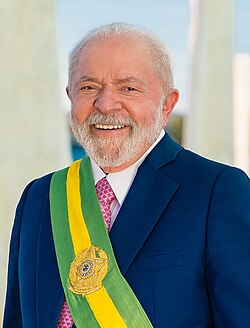
Luiz Inácio Lula da Silva
Former metalworker and union leader, President of Brazil from 2003 to 2011 and again from 2023.
Biography
Luiz Inácio da Silva was born in 1945 in Caetés, then part of Garanhuns in Pernambuco, the seventh of eight children of poor farmers; in 1952 his mother took the children south to São Paulo state to rejoin his father. He left school after the second grade, worked from the age of eight, and after vocational training became a metalworker, losing a finger in a factory accident in 1964. Working at Villares Metals, he rose through the ABC Metalworkers' Union, which he led from 1975, and headed the strikes of 1978-1980 against the military government's wage policy, for which he was jailed for a month in 1980.
In February 1980 he co-founded the Workers' Party, and in 1986 he was elected federal deputy for São Paulo with more votes than any other candidate in the country. He lost the presidential elections of 1989, 1994 and 1998 before winning in 2002 and again in 2006. His two terms, from 2003 to 2011, kept a cautious fiscal line while expanding social programmes such as Bolsa Família, and were also marked by the Mensalão vote-buying scandal. He left office very popular and was succeeded by Dilma Rousseff.
Convicted of corruption and money laundering in the Operation Car Wash cases, he was jailed in April 2018, barred from that year's election and freed in November 2019 after 580 days. In 2021 the Supreme Federal Court annulled his convictions on jurisdictional grounds and ruled that the trial judge, Sergio Moro, had been biased. He defeated Jair Bolsonaro in the 2022 run-off and began a third term on 1 January 2023, days before Bolsonaro supporters attacked federal buildings in Brasília.
Offices held
Fernando Henrique Cardoso
2 terms
- Jan 1, 2003 – Jan 1, 2011 Preceded by Fernando Henrique Cardoso Succeeded by Dilma Rousseff
- from Jan 1, 2023 Preceded by Jair Bolsonaro
Affiliations
Party membership
- from Feb 10, 1980 Workers' Party (Brazil) co-founder


