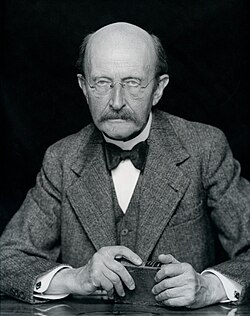
Max Planck
April 23, 1858 – October 4, 1947
German physicist who founded quantum theory in 1900; Nobel Prize in Physics 1918.
Biography
Max Planck was a German theoretical physicist who founded quantum theory. In 1900, to explain black-body radiation, he proposed that energy is emitted in discrete units, or quanta. He received the Nobel Prize in Physics in 1918.
He held the chair of theoretical physics in Berlin for decades and supported Albert Einstein's work on relativity. He led German science institutions, including the Kaiser Wilhelm Society.
Under the Nazi regime he tried to protect colleagues and science; his son Erwin was executed in 1945 for involvement in the plot against Hitler. The Max Planck Society is named after him.
Affiliations
Education
- from Jan 1, 1874 LMU Munich
Employment
- Jan 1, 1885 – Jan 1, 1889 Kiel University
- Humboldt University of Berlin
Party membership
Timeline
1859
1865
1871
1877
1883
1889
1895
1901
1907
1913
1919
1925
1931
1937
1943
