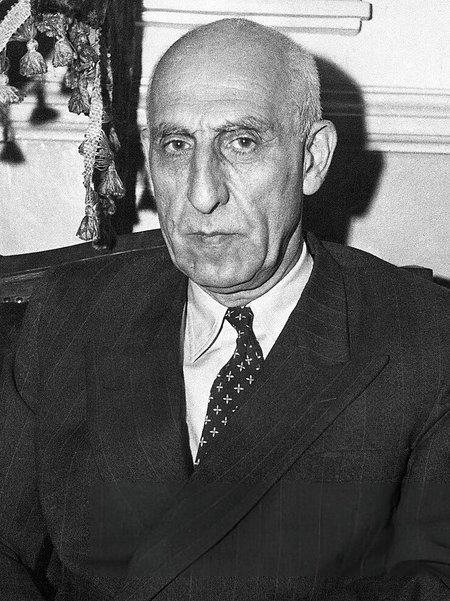
Mohammad Mosaddegh
Iranian Prime Minister from 1951 to 1953 who nationalised the oil industry and was overthrown in a coup backed by Britain and the United States.
Biography
Mohammad Mosaddegh was born in 1882 into a prominent Iranian family; his father was a Qajar finance minister and his mother a great-granddaughter of Fath-Ali Shah. He studied at Sciences Po in Paris from 1909 and in 1913 received a doctorate in law from the University of Neuchâtel, the first Iranian to earn a law doctorate at a European university. Back in Iran he taught at the Tehran School of Political Science.
Elected to the first Majlis during the Constitutional Revolution, he could not take his seat because he was under age. He protested the Anglo-Persian Agreement of 1919 from Switzerland, then served as governor of Fars, finance minister, governor of Azerbaijan and, in 1923, foreign minister, and sat in the Majlis in the 1920s and again from 1944.
A member of the National Front from its formation in 1949, Mosaddegh led the Majlis in March 1951 to nationalise the oil industry run by the Anglo-Iranian Oil Company. He became prime minister in April 1951 and faced a British blockade and boycott in the Abadan Crisis. He left office in July 1952 but was reappointed a few days later, this time also taking the defence ministry. In August 1953 he was overthrown in a coup organised with the British and US intelligence services. He was tried for treason, spent three years in prison, and was kept under house arrest until his death in 1967; he was buried at his own home to avoid public unrest. In 2013 the US government formally acknowledged its role in the coup.
Affiliations
Education
- Jan 1, 1909 – Jan 1, 1911 Sciences Po
- Jan 1, 1911 – Jan 1, 1913 University of Neuchâtel Doctorate of Laws, June 1913
- University of Paris


