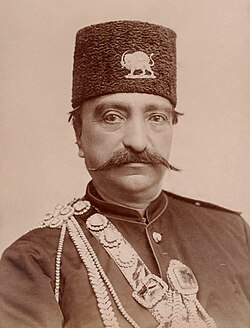
Naser al-Din Shah Qajar
Qajar shah of Iran for almost fifty years, who opened the country to Western concessions; assassinated in 1896.
Biography
Naser al-Din was born in 1831 at Kahnamu near Tabriz, the eldest son of the future Mohammad Shah Qajar and Malek Jahan Khanom. Named crown prince at the age of four in 1835, he was given the nominal governorship of Azerbaijan under a series of regents. When his father died in September 1848 he took the throne with the help of Amir Kabir, while his mother became the most powerful figure at court.
His early reign brought reforms, including the first official newspaper and the Dar al-Funun, Iran's first college of higher learning, but under pressure from a court faction led by the queen mother the shah demoted his reforming chief minister Amir Kabir and had him executed in January 1852. That year a Babi attempt on the shah's life was followed by the killing of thousands of Babis. In 1856 his forces took Herat after a long siege, which led Britain to declare war on Iran.
The shah took an interest in modern technology, introducing the telegraph, postal services and roads, and was an early and enthusiastic photographer. He was the first modern Iranian ruler to tour Europe, in 1873, 1878 and 1889, and published diaries of his travels. To raise money he sold sweeping rights to foreigners: the 1872 Reuter concession was cancelled within about a year after protests and Russian objections, and the 1890 tobacco monopoly granted to a British company provoked a nationwide boycott backed by the clergy that forced its withdrawal.
Increasingly autocratic in his later years, he resisted calls for reform while tax farming fed resentment of a corrupt government. After almost 48 years on the throne he was shot dead on 1 May 1896 at the Shah Abdol-Azim shrine near Tehran by Mirza Reza Kermani, a follower of Jamal al-Din al-Afghani. His reign is seen as a prelude to the Constitutional Revolution under his son Mozaffar ad-Din Shah.
Offices held
Mohammad Shah Qajar Succeeded by
Mozaffar ad-Din Shah Qajar