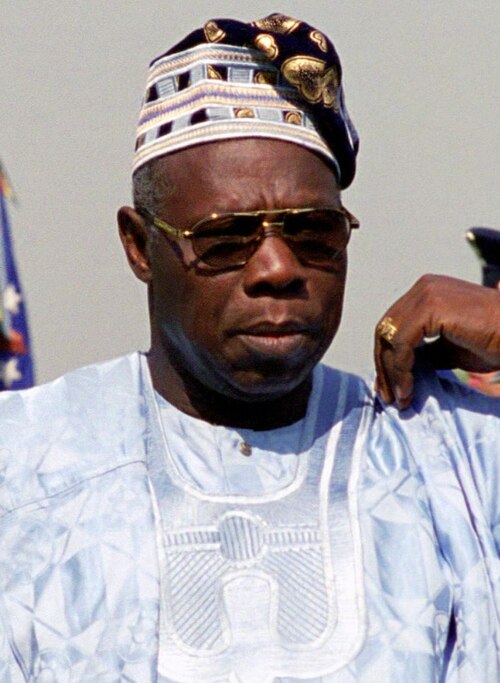
Olusegun Obasanjo
Nigerian general who led a military government from 1976 to 1979 and was elected President of Nigeria for 1999 to 2007.
Biography
Olusegun Obasanjo was born around 1937 in Ibogun-Olaogun, in the Owu Yoruba area of what is now Ogun State, and was schooled in Abeokuta. Unable to afford university fees, he joined the Nigerian Army in 1958 to train as an engineer, passing through Mons Officer Cadet School in England. He served with a UN force in the Congo in 1960-61, studied military engineering in England and India, and in the civil war first held Ibadan for the federal side and then, from May 1969, commanded the Third Division on the southern front, whose final offensive brought Biafra's surrender in January 1970.
After the 1975 coup he became chief of staff to the new head of state Murtala Muhammed, and when Murtala was killed in a failed coup in February 1976 the Supreme Military Council made Obasanjo head of state. His government cut spending, expanded free schooling, issued the Land Use Decree, and backed movements against white minority rule in southern Africa while moving Nigeria closer to the United States. It also drew criticism for repression, such as the destruction of Fela Kuti's compound. He oversaw the drafting of a presidential constitution and in October 1979 handed power to the elected president Shehu Shagari.
In retirement he farmed at Ota, wrote books, co-chaired the Commonwealth Eminent Persons Group on South Africa in 1986 and mediated in several African conflicts. A critic of Sani Abacha's regime, he was arrested in 1995, convicted by a military court of concealing a coup plot and imprisoned until Abacha's death in 1998; in prison he became a born-again Christian.
He then joined the Peoples Democratic Party and won the 1999 presidential election. As civilian president until 2007 he retired politicized officers, created anti-corruption agencies, privatized state enterprises, secured large debt relief and settled the Bakassi dispute with Cameroon, and chaired the African Union from 2004 to 2006, though his attempt to secure a third term failed. He later broke with the PDP, rejoined it in 2018, and in 2022 mediated the talks that ended the Tigray War.
Offices held
Murtala Muhammed Succeeded by
Umaru Musa Yar'Adua
2 terms
- Feb 13, 1976 – Oct 1, 1979 Preceded by Murtala Muhammed Succeeded by Shehu Shagari
- May 29, 1999 – May 29, 2007 Preceded by Abdulsalami Abubakar Succeeded by Umaru Musa Yar'Adua
Military service
Affiliations
Education
- from Sep 1, 1958 Mons Officer Cadet School Six months of officer training at Mons from September 1958; commissioned there
- Jan 1, 1974 – Dec 31, 1974 Royal College of Defence Studies Course at the Royal College of Defence Studies, 1974
- Defence Services Staff College
Party membership
- Oct 28, 1998 – Feb 16, 2015 Peoples Democratic Party (Nigeria)
- from Nov 20, 2018 Peoples Democratic Party (Nigeria) Announced his return to the PDP on 20 November 2018 (second membership; first is affiliation 9328)


