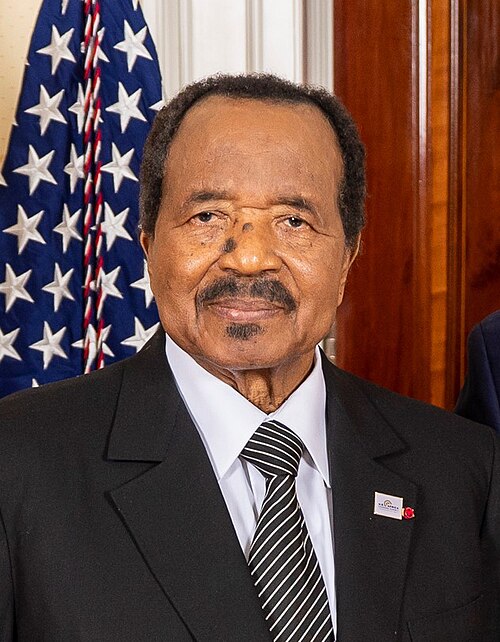
Paul Biya
Cameroonian politician, President of Cameroon since 1982 after seven years as Prime Minister.
Biography
Paul Biya was born in 1933 in Mvomeka'a, in the south of French Cameroon; his father, a Catholic catechist, hoped he would enter the priesthood. He studied at the Lycée Général Leclerc in Yaoundé and in Paris at the Lycée Louis-le-Grand and the Institut des hautes études d'outre-mer, graduating in public law in 1961, and also studied at Sciences Po.
He rose quickly in the administration of President Ahmadou Ahidjo, heading the cabinet of the education minister from 1964 and, from 1968, serving as secretary-general of the presidency with ministerial rank. Ahidjo made him prime minister in June 1975, and a 1979 law named the prime minister as constitutional successor; when Ahidjo unexpectedly resigned in November 1982, Biya became president.
A rift with Ahidjo soon followed. Biya took over the ruling Cameroon National Union in 1983, survived a bloody coup attempt by palace guards in April 1984 and in 1985 turned the party into the Cameroon People's Democratic Movement. Under pressure he legalised opposition parties in 1990, then won the disputed 1992 multiparty election with about 40 percent of the vote.
He has since been re-elected in 1997, 2004, 2011, 2018 and 2025 amid repeated allegations of fraud, after parliament removed presidential term limits in 2008. He took the Bakassi peninsula dispute with Nigeria to the International Court of Justice and in 2006 signed the Greentree Agreement that settled it. His long rule is widely described as authoritarian, and his strongest opposition has come from the English-speaking west of the country.
Offices held
Salomon Tandeng Muna Succeeded by
Bello Bouba Maigari
Affiliations
Party membership
Education
- Lycée Louis-le-Grand Lycée Louis-le-Grand, Paris; no dates given
- Sciences Po Institute of Political Studies, Paris (infobox); no dates given
- University of Paris
- École nationale d'administration


