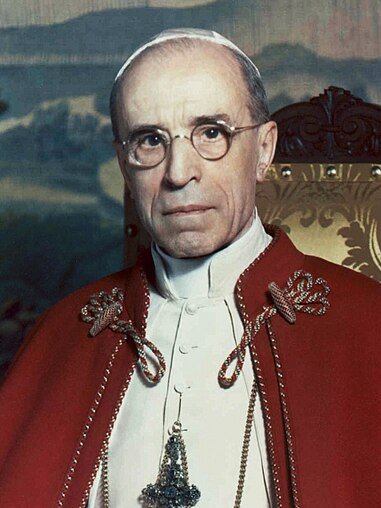
Pius XII
March 2, 1876 – October 9, 1958
Italian pope from 1939 to 1958, during the Second World War and the early Cold War.
Biography
Eugenio Pacelli was born in Rome in 1876 into a family long tied to the papal administration. He studied at the Capranica college, the Gregorian University and the Sapienza, completing most of his seminary training from home, and was ordained in 1899 before taking a doctorate centred on concordats and canon law.
From 1901 he worked in the Vatican's office for extraordinary ecclesiastical affairs, becoming its secretary in 1914. Appointed nuncio to Bavaria in 1917 and to Germany in 1920, he negotiated concordats with German states and moved his nunciature to Berlin after the 1924 Bavarian concordat. As cardinal secretary of state from 1930 he signed the 1933 Reichskonkordat with Nazi Germany, and he was named camerlengo in 1935.
Elected pope on his birthday in March 1939, he led the church through the Second World War with the Vatican officially neutral. His conduct toward the Holocaust, including his public reticence about the fate of Europe's Jews, remains disputed: defenders cite discreet diplomacy and rescue work, critics the absence of explicit condemnation or orders to protect Jews.
After the war he excommunicated Catholics who professed communism, invoked papal infallibility to define the dogma of the Assumption and internationalised the College of Cardinals. He died at Castel Gandolfo in October 1958 and was declared venerable in 2009.
Offices held
Affiliations
Education
- Jan 1, 1894 – Jan 1, 1895 Pontifical Gregorian University Philosophy studies; left after the first academic year
- from Jan 1, 1894 Sapienza University of Rome Modern languages and history
