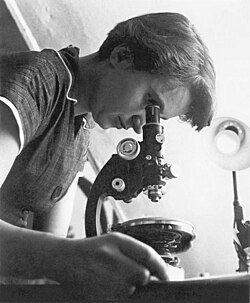
Rosalind Franklin
July 25, 1920 – April 16, 1958
English chemist whose X-ray images of DNA were key evidence for its double-helix structure.
Biography
Rosalind Franklin was an English chemist and X-ray crystallographer, born in London in 1920 into a prosperous Jewish family. She attended St Paul's Girls' School and read natural sciences at Newnham College, Cambridge, graduating in 1941. After a short and frustrating spell in Ronald Norrish's laboratory, she spent the war years at the British Coal Utilisation Research Association, and her studies of the structure of coal earned her a Cambridge PhD in 1945.
In 1947 she moved to Paris to work under Jacques Mering at the Laboratoire Central des Services Chimiques de l'État, where she became an expert in X-ray diffraction. She joined King's College London in 1951 as a research associate and produced diffraction images of DNA, among them Photo 51, taken by her student Raymond Gosling. Maurice Wilkins showed that image to James Watson without her permission, and her data helped Watson and Francis Crick arrive at the double-helix model in 1953.
Disagreements with John Randall and Wilkins led her to move to Birkbeck College in 1953, where, under J. D. Bernal, she led pioneering work on the structure of viruses, including tobacco mosaic virus. She died of ovarian cancer in 1958, aged 37. Her colleague Aaron Klug continued the virus research and won the 1982 Nobel Prize in Chemistry, while her own contribution to the DNA discovery was widely acknowledged only after her death.
Affiliations
Education
- Jan 1, 1931 – Jan 1, 1938 St Paul's Girls' School
- Jan 1, 1938 – Jan 1, 1941 Newnham College, Cambridge
- University of Cambridge
Employment
- Jan 1, 1942 – Jan 1, 1947 British Coal Utilisation Research Association assistant research officer; coal research for her PhD
- Jan 1, 1951 – Jan 1, 1953 King's College London
- Jan 1, 1953 – Apr 16, 1958 Birkbeck, University of London

