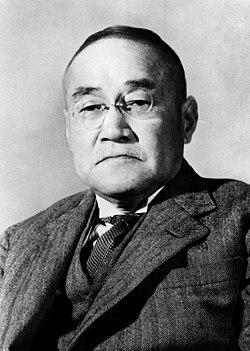
Biography
Shigeru Yoshida was born in Tokyo in 1878 and adopted as a small child by a wealthy Yokohama businessman. After graduating in law from Tokyo Imperial University in 1906 he joined the foreign ministry, serving mostly in China and later as vice minister for foreign affairs from 1928, ambassador to Italy and ambassador to the United Kingdom from 1936 to 1938. He opposed war with Britain and the United States and was briefly detained in 1945 over his ties to Prince Konoe's peace efforts.
After Japan's surrender he became foreign minister, and in May 1946 prime minister, taking over the Liberal Party when its leader Ichirō Hatoyama was purged. His first government oversaw the adoption of the new Constitution of Japan before he lost the 1947 election.
He returned to power in October 1948 and governed until December 1954. He carried out the austerity of the Dodge Line, signed the Treaty of San Francisco and the security treaty with the United States in 1951, and set the course later called the Yoshida Doctrine: economic recovery under American military protection. Defections to Hatoyama's new party forced him out in 1954. He stayed in the House of Representatives until 1963 and died in Ōiso in 1967.
Offices held
Kijūrō Shidehara Succeeded by
Ichirō Hatoyama
2 terms
- May 22, 1946 – May 24, 1947 Preceded by Kijūrō Shidehara Succeeded by Tetsu Katayama
- Oct 15, 1948 – Dec 10, 1954 Preceded by Hitoshi Ashida Succeeded by Ichirō Hatoyama
Affiliations
Party membership
- May 1, 1946 – Mar 15, 1948 Liberal Party (Japan, 1945)
- Mar 15, 1948 – Mar 1, 1950 Democratic Liberal Party (Japan) Party formed from the Liberal Party in March 1948 and merged into the new Liberal Party in March 1950
- Mar 1, 1950 – Jan 1, 1955 Liberal Party (Japan, 1950) Infobox: LP 1950-1955 (founder); entity founded March 1950 (month precision). End year 1955 per infobox
- Jan 1, 1957 – Oct 20, 1967 Liberal Democratic Party (Japan)
Education
- Gakushuin University
- University of Tokyo Law degree, Tokyo Imperial University, 1906
