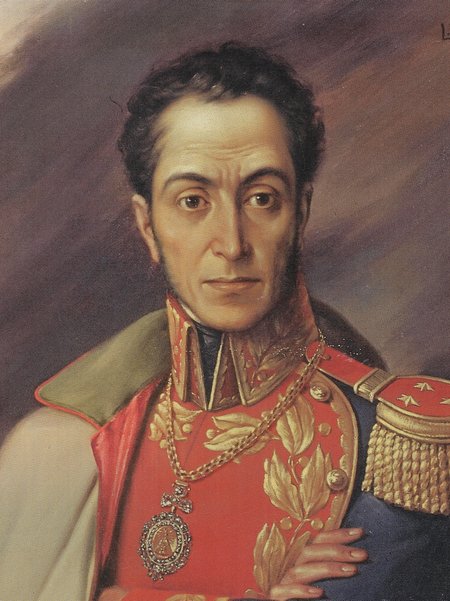
Simón Bolívar
July 24, 1783 – December 17, 1830
Venezuelan military and political leader who led the independence of Venezuela, Colombia, Ecuador, Peru and Bolivia from Spain.
Biography
Simón Bolívar was born in Caracas in 1783 into a wealthy Creole family. Orphaned young, he was educated in Spain and travelled in Europe, where he was influenced by the ideas of the Enlightenment. He joined the movement for independence after Napoleon's invasion of Spain in 1808 weakened Spanish rule in America.
After early defeats and exile, he crossed the Andes in 1819 and won the Battle of Boyacá, which freed New Granada. He became president of Gran Colombia, a union of today's Venezuela, Colombia, Ecuador and Panama, and won at Carabobo in 1821. He then led the campaign that, with Sucre's victory at Ayacucho in 1824, ended Spanish rule in Peru, and Bolivia was named after him.
His plans for a large, united state with a strong central government met growing opposition. Gran Colombia broke apart in his last years, and he survived an assassination attempt in 1828. He died of tuberculosis in 1830. He is called El Libertador and is a national hero in much of South America.
Offices held
José Antonio Páez
2 terms
- Aug 7, 1813 – Jul 16, 1814
- Oct 1, 1817 – Feb 24, 1819 Succeeded by José Antonio Páez
José Miguel Pey Succeeded by
Domingo Caycedo
Also President of 2 others
- Peru Feb 8, 1824 – Jan 28, 1827 Preceded by Antonio José de Sucre · Succeeded by Andrés de Santa Cruz
- Bolivia Aug 12, 1825 – Dec 29, 1825 Succeeded by Antonio José de Sucre

