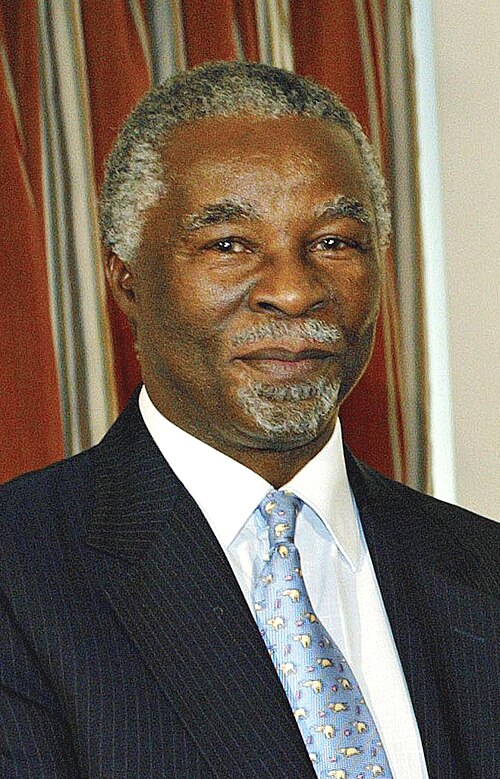
Thabo Mbeki
South African politician who succeeded Nelson Mandela as President of South Africa, serving from 1999 to 2008.
Biography
Thabo Mbeki was born in 1942 in Mbewuleni in the Transkei, the son of the ANC and Communist Party activists Govan and Epainette Mbeki. He joined the ANC Youth League at fourteen and was expelled from Lovedale school in 1959 for leading a boycott. After the ANC was banned he moved to Johannesburg, where he was recruited into the South African Communist Party, and in 1962 the movement sent him abroad. He took a bachelor's and then a master's degree in economics at the University of Sussex, worked for the ANC in London, and in 1969-1970 trained at the Lenin Institute in Moscow.
From 1971 he was based at the ANC's exile headquarters in Lusaka as a protege of Oliver Tambo, whose speeches he drafted. He helped set up ANC bases in Botswana and Swaziland, was the movement's first representative in Nigeria, and from 1978 was Tambo's political secretary and head of the information department. In the late 1980s he led secret talks with representatives of the apartheid government that helped bring about the unbanning of the ANC in 1990.
After the 1994 election he became deputy president under Nelson Mandela, succeeded him as ANC president in 1997 and as president of South Africa in 1999, and was re-elected in 2004. His governments pursued market-friendly economic policies and broad black economic empowerment, and he promoted an 'African renaissance', the New Partnership for Africa's Development and the African Union, which he chaired first. He mediated in Zimbabwe, where his 'quiet diplomacy' towards Robert Mugabe was criticised, and his government's delay in providing antiretroviral treatment, influenced by his doubts about the causes of AIDS, has been blamed for many preventable deaths.
After dismissing Jacob Zuma as deputy president in 2005, Mbeki lost the ANC presidency to him at the Polokwane conference in December 2007. In September 2008 the ANC recalled him and he resigned as president of South Africa. He stayed on as mediator in Zimbabwe after leaving office, where he had brokered a power-sharing agreement in September 2008, and became chancellor of the University of South Africa in 2016.
Offices held
Nelson Mandela Succeeded by
Jacob Zuma
Also President of 1 other
- South Africa Jun 14, 1999 – Sep 24, 2008 Succeeded by Ivy Matsepe-Casaburri
Affiliations
Party membership
- from Jan 1, 1960 South African Communist Party recruited into the SACP in Johannesburg, 1960-62; infobox lists SACP as other affiliation; no end date
- African National Congress
Education
- Jan 1, 1962 – Oct 1, 1966 University of Sussex BA economics 1965, then MA; moved to London in October 1966
- Feb 1, 1969 – Jan 1, 1970 International Lenin School Lenin Institute, Moscow, from February 1969
- from Jan 1, 1995 University of South Africa
- from Jan 1, 2000 Glasgow Caledonian University
- from Jan 1, 2004 Stellenbosch University
- University of London

