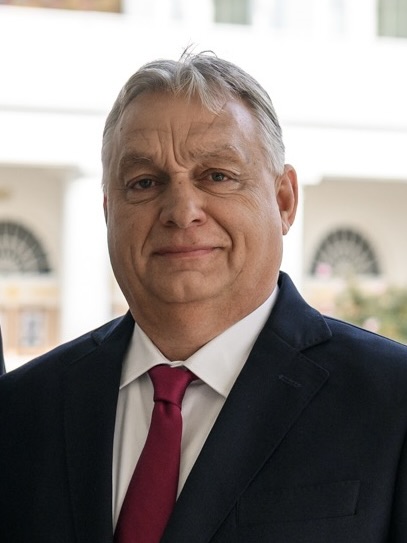
Viktor Orbán
Hungarian politician who led Fidesz and was Prime Minister of Hungary in 1998-2002 and again from 2010.
Biography
Viktor Orbán was born in 1963 in Székesfehérvár and grew up in Alcsútdoboz and Felcsút in Fejér County. After military service he studied law at Eötvös Loránd University in Budapest from 1983, where he joined a residential college for law students and wrote his thesis on the Polish Solidarity movement. In 1988 he helped found Fidesz, then a liberal youth movement, and in 1989-90 he held a research fellowship at Pembroke College, Oxford.
He entered parliament in 1990, led Fidesz's parliamentary group until 1993 and has led the party for most of the time since. At 35 he became prime minister in 1998, heading a conservative coalition during which Hungary joined NATO. He lost in 2002 and spent eight years in opposition.
Fidesz returned in 2010 with a two-thirds majority, repeated in 2014, 2018 and 2022, and Orbán became Hungary's longest-serving prime minister. His governments rewrote the constitution and changed the courts and media regulation, which the European Commission and others said weakened judicial independence and press pluralism. He described his model as an "illiberal state", opposed EU migration policy, restricted LGBTQ rights, and kept close ties with Russia and China.
Péter Magyar's Tisza party defeated him in a landslide in April 2026, and he left office in May 2026 while remaining Fidesz leader.
Offices held
Gyula Horn Succeeded by
Péter Magyar
2 terms
- Jul 8, 1998 – May 27, 2002 Preceded by Gyula Horn Succeeded by Péter Medgyessy
- May 29, 2010 – May 9, 2026 Preceded by Gordon Bajnai Succeeded by Péter Magyar
Affiliations
Education
- from Jan 1, 1983 Eötvös Loránd University law (JD)
- Sep 1, 1989 – Jan 1, 1990 University of Oxford research fellowship, Pembroke College, Oxford
Party membership
- from Jan 1, 1988 Fidesz
