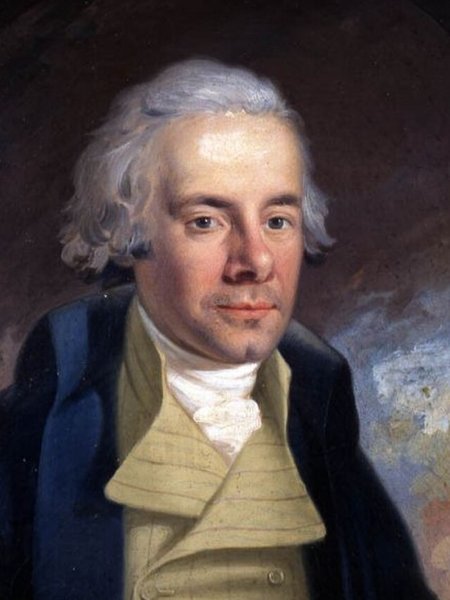
William Wilberforce
August 24, 1759 – July 29, 1833
British MP and evangelical who led the campaign that abolished the British slave trade in 1807.
Biography
William Wilberforce was born in Hull in 1759, the only son of a wealthy merchant family. He attended Hull Grammar School and Pocklington School and in 1776 went up to St John's College, Cambridge, where he lived a sociable life, befriended William Pitt and took his degree in 1781.
In 1780, still a student, he was elected MP for Kingston upon Hull, and in 1784 he won the county seat of Yorkshire, which he held until 1812. He sat as an independent but was a close ally of Pitt. A religious conversion in 1785 made him an evangelical Anglican, and he resolved to stay in politics in the service of moral and social reform.
From 1787, urged on by Thomas Clarkson and other campaigners, he led the parliamentary fight against the British slave trade. His motions and bills failed again and again through the 1790s and early 1800s, until a change of tactics in 1806 and a large Commons majority in February 1807 carried the Slave Trade Act. He also backed missionary work in India, the Sierra Leone colony, the Church Mission Society and the Society for the Prevention of Cruelty to Animals, while his conservatism led him to support repressive measures at home.
Failing health made him give up his seat in the mid-1820s, but he kept working for the abolition of slavery itself. He died in London on 29 July 1833, days after learning that the Slavery Abolition Act was assured of passage, and was buried in Westminster Abbey.
Offices held
Affiliations
Education
- Jan 1, 1767 – Jan 1, 1768 Hull Grammar School Hull Grammar School, under Joseph Milner
- Jan 1, 1771 – Jan 1, 1776 Pocklington School Pocklington School
- Oct 1, 1776 – Jan 1, 1781 St John's College, Cambridge St John's College, Cambridge; matriculated October 1776, B.A. 1781 (M.A. 1788)
