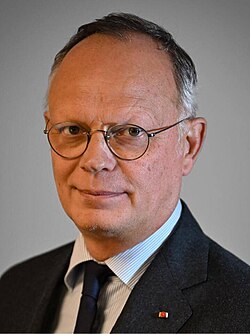
Édouard Philippe
Prime Minister of France from 2017 to 2020
Biography
Édouard Philippe was born in Rouen in 1970, the son of two teachers, and grew up in a left-leaning family. He took his baccalauréat at a Franco-German school in Bonn, graduated from Sciences Po in 1992 and attended the École nationale d'administration from 1995 to 1997. As a student he admired Michel Rocard and briefly belonged to the Socialist Party.
After ENA he joined the Council of State, specialising in public procurement law. From 2001 he worked in Le Havre as a deputy to mayor Antoine Rufenacht, and in 2002 he followed Alain Juppé into the new Union for a Popular Movement. Between 2007 and 2010 he ran public affairs for the nuclear group Areva. He became mayor of Le Havre in 2010 and sat in the National Assembly for Seine-Maritime from 2012 to 2017.
Emmanuel Macron appointed him prime minister on 15 May 2017, while he was still a member of The Republicans. His government passed labour-law and tax reforms, faced the yellow vests protests from late 2018 and imposed a national lockdown in March 2020 at the start of the COVID-19 pandemic. He resigned on 3 July 2020, shortly after winning back the mayoralty of Le Havre.
In 2021 he founded the centre-right party Horizons, which joined the presidential coalition, and in September 2024 he announced that he would run in the 2027 presidential election. Since 2024 prosecutors have been investigating his conduct as mayor for suspected misuse of public funds and favouritism.
Offices held
Bernard Cazeneuve Succeeded by
Jean Castex
Affiliations
Party membership
- Jan 1, 1990 – Jan 1, 1992 Socialist Party (France)
- Jan 1, 2002 – May 30, 2015 Union for a Popular Movement
- May 30, 2015 – Jan 1, 2017 The Republicans (France)
- from Oct 9, 2021 Horizons (political party) Founder of Horizons
Education
- Jan 1, 1995 – Jan 1, 1997 École nationale d'administration ENA, Marc Bloch cohort
- Sciences Po Sciences Po, graduated 1992
Employment
- from Jan 1, 1997 Conseil d'État (France) Council of State, public procurement law

