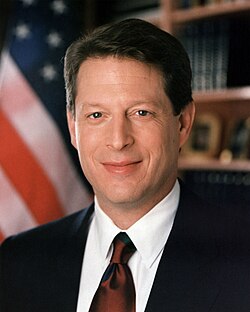
Al Gore
45th vice president of the United States (1993-2001) under Bill Clinton and Democratic nominee in the disputed 2000 presidential election. He later became a climate campaigner and shared the 2007 Nobel Peace Prize.
Biography
Albert Arnold Gore Jr. was born in Washington, D.C., in 1948, the son of Senator Albert Gore Sr. of Tennessee. He graduated from Harvard College in 1969, where a class with Roger Revelle drew him to climate change, and served in the U.S. Army in Vietnam as a military journalist. He then studied at Vanderbilt's divinity and law schools while working as an investigative reporter for The Tennessean.
In 1976 he left law school to run for his father's old House seat. He served in the House from 1977 to 1985 and in the Senate from 1985 to 1993, and sought the Democratic presidential nomination in 1988. Bill Clinton chose him as his running mate in 1992, and he served two terms as vice president, from 1993 to 2001.
As the Democratic nominee in 2000 he won the national popular vote but lost the Electoral College to George W. Bush after the Supreme Court halted the Florida recount in Bush v. Gore.
He then turned to climate activism and business. The documentary An Inconvenient Truth (2006) won an Academy Award, he helped organise the Live Earth concerts in 2007, and he shared the 2007 Nobel Peace Prize with the Intergovernmental Panel on Climate Change. He co-founded and chairs Generation Investment Management, founded the Climate Reality Project, co-founded Current TV, and became a partner at the venture firm Kleiner Perkins.
Offices held
Dan Quayle Succeeded by
Dick Cheney
Military service
Affiliations
Education
- Jan 1, 1965 – Jan 1, 1969 Harvard College BA in government
- Jan 1, 1971 – Jan 1, 1976 Vanderbilt University Divinity School 1971-72, Law School 1974-76; no degree
Employment
- Jan 1, 1971 – Jan 1, 1976 The Tennessean investigative reporter
- Kleiner Perkins partner, head of its climate change solutions group

