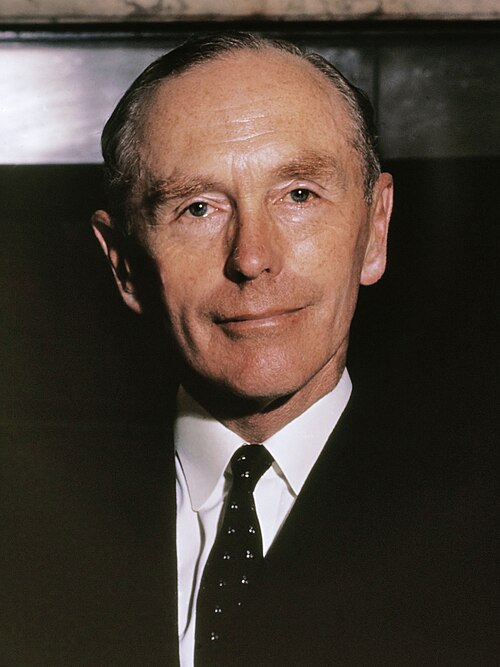
Alec Douglas-Home
July 2, 1903 – October 9, 1995
British Conservative politician who was Prime Minister of the United Kingdom from 1963 to 1964 and twice Foreign Secretary.
Biography
Alec Douglas-Home was born in Mayfair in 1903 into a Scottish noble family and was known for most of his career as Lord Dunglass and then the Earl of Home. Educated at Eton and Christ Church, Oxford, he was also a first-class cricketer. He entered the Commons in 1931 as a Unionist MP for Lanark and from 1937 was parliamentary private secretary to Neville Chamberlain, defending the Munich agreement for the rest of his life.
Spinal tuberculosis kept him out of politics for nearly two years from 1940. He lost his seat in 1945, regained it in 1950, and in 1951 succeeded his father as Earl of Home and moved to the Lords. He was Minister of State for Scotland, Commonwealth Relations Secretary, Leader of the House of Lords and Lord President of the Council, and from 1960 Foreign Secretary, supporting the United States in the Cuban Missile Crisis and signing the Partial Nuclear Test Ban Treaty in Moscow in 1963.
When Harold Macmillan resigned in October 1963, Home was unexpectedly chosen to succeed him. He renounced his peerage and won a by-election to sit in the Commons. His year in office, the second briefest premiership of the century, ended with narrow defeat by Harold Wilson in October 1964, and he gave up the Conservative leadership in 1965. He returned as Foreign Secretary under Edward Heath from 1970 to 1974, failing to settle the Rhodesian question, and then entered the Lords as a life peer. He died in 1995.
Offices held
3 terms
- Oct 27, 1931 – Jun 15, 1945
- Feb 23, 1950 – Jul 11, 1951
- Nov 7, 1963 – Sep 20, 1974
Harold Macmillan Succeeded by
Edward Heath
Harold Macmillan Succeeded by
Harold Wilson
Harold Wilson Succeeded by
Edward Heath
Affiliations
Party membership
- Jan 1, 1931 – Jan 1, 1965 Unionist Party (Scotland) Scottish Unionists, merged into the Conservative Party in 1965
- from Jan 1, 1965 Conservative Party (UK)
Education
- Eton College
- Christ Church, Oxford BA in modern history, 1925

