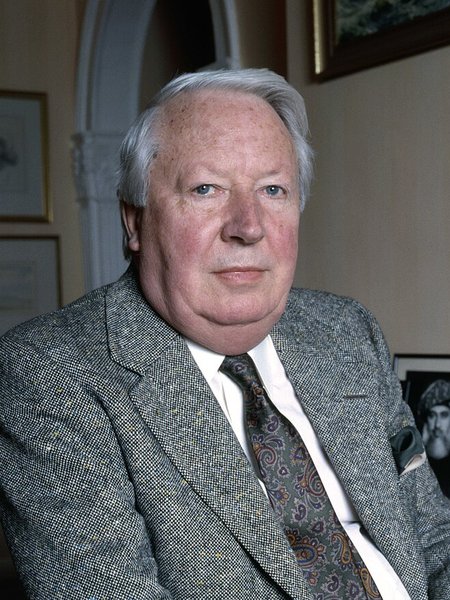
Edward Heath
British Conservative politician who was Prime Minister of the United Kingdom from 1970 to 1974 and took the country into the European Economic Community.
Biography
Edward Heath was born in Broadstairs, Kent, in 1916, the son of a carpenter and a lady's maid. He studied philosophy, politics and economics at Balliol College, Oxford, where he was active in student politics, and served in the Royal Artillery during the Second World War, rising to lieutenant colonel. After a short spell in the civil service he was elected MP for Bexley in 1950.
Heath rose through the whips' office to become Chief Whip under Anthony Eden, then served Harold Macmillan as Minister of Labour and Lord Privy Seal, leading Britain's first bid to join the European Economic Community, and Alec Douglas-Home as President of the Board of Trade. He was elected Conservative leader in 1965, lost the 1966 election, and won an unexpected victory in 1970.
As prime minister he took Britain into the EEC in 1973, carried through decimalisation and local government reform, and introduced direct rule and internment in Northern Ireland. Conflict with the trade unions culminated in the miners' strike and the Three-Day Week, and he lost his majority in February 1974. After a second defeat that October, Margaret Thatcher displaced him as leader in 1975. He stayed in the Commons as a critic of Thatcherism until 2001, becoming Father of the House, and was also known as a yachtsman and musician. He died in 2005.
Offices held
Frederick Erroll, 1st Baron Erroll of Hale Succeeded by
Douglas Jay
Alec Douglas-Home Succeeded by
Margaret Thatcher
Alec Douglas-Home Succeeded by
Margaret Thatcher
2 terms
- Jul 28, 1965 – Jun 19, 1970 Preceded by Alec Douglas-Home Succeeded by Harold Wilson
- Mar 4, 1974 – Feb 11, 1975 Preceded by Harold Wilson Succeeded by Margaret Thatcher
Harold Wilson Succeeded by
Harold Wilson
Military service
Affiliations
Education
- from Jan 1, 1935 Balliol College, Oxford Read PPE


