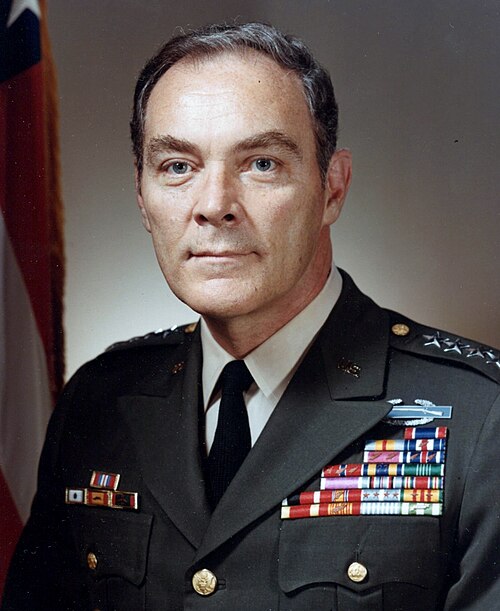
Alexander Haig
December 2, 1924 – February 20, 2010
American general and statesman who was White House chief of staff under Nixon and Ford, NATO Supreme Allied Commander Europe, and Reagan's secretary of state (1981-1982).
Biography
Alexander Haig was a United States Army officer who moved between military command and the highest levels of the civilian government. After studying at Notre Dame he graduated from West Point in 1947, served in Korea and Vietnam, and added a business degree from Columbia and a master's from Georgetown along with the Naval and Army war colleges.
In 1969 he joined Henry Kissinger's National Security Council staff and became deputy national security advisor in 1970. He was briefly vice chief of staff of the Army in 1973 before Richard Nixon made him White House chief of staff in May of that year. He ran the White House through the last months of the Watergate crisis and stayed on into the Ford administration until September 1974.
Haig then served as Supreme Allied Commander Europe until 1979 and was president of United Technologies. Ronald Reagan appointed him secretary of state in 1981; after the attempt on Reagan's life he drew criticism for saying he was "in control" at the White House. He resigned in 1982 after clashes within the administration and sought the Republican presidential nomination in 1988 without success. He died in 2010.
Offices held
Andrew Goodpaster Succeeded by
Bernard W. Rogers
David D. Newsom Succeeded by
Walter J. Stoessel Jr.
Military service
Affiliations
Education
- Jan 1, 1944 – Jun 3, 1947 United States Military Academy B.S., United States Military Academy, class of 1947
- University of Notre Dame University of Notre Dame
- Naval War College Naval War College
- Georgetown University M.A. in international relations, Georgetown University
- United States Army War College United States Army War College
- Columbia University MBA, Columbia Business School


