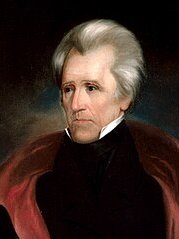
Andrew Jackson
Andrew Jackson (1767–1845) was the seventh president of the United States, serving from 1829 to 1837. He rose to fame as a U.S. Army general and served in both houses of the U.S. Congress. His political philosophy, known as Jacksonian democracy, dominated his presidency. His legacy is controversial: he is praised for preserving the union of states and criticized for his policies toward Native Americans.
Biography
Andrew Jackson was born on the Carolina frontier and rose as a lawyer, planter and militia general in Tennessee. He enslaved many people on his Hermitage plantation. He became a national hero after defeating the British at New Orleans in January 1815, and he invaded Spanish Florida during the First Seminole War.
He narrowly lost the 1824 election and won the presidency in 1828 at the head of the new Democratic Party. As president (1829-1837) he signed the Indian Removal Act of 1830, which led to the forced expulsion of the Cherokee and other nations on the Trail of Tears.
He vetoed the recharter of the Second Bank of the United States and faced down South Carolina in the Nullification Crisis of 1832-33. His supporters saw him as a champion of the common man; his critics called him "King Andrew". He died at the Hermitage in 1845.
Offices held
2 terms
- Sep 26, 1797 – Apr 1, 1798
- Mar 4, 1823 – Oct 14, 1825
John Quincy Adams Succeeded by
Martin Van Buren


