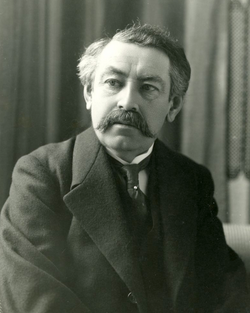
Aristide Briand
March 28, 1862 – March 7, 1932
Eleven-time Prime Minister of France; Nobel Peace Prize 1926
Biography
Aristide Briand was born in Nantes in 1862 to a family of modest means. After studying law in Paris he turned to journalism and socialist politics, writing for left-wing papers and working with Jean Jaures; at a workers' congress in 1894 he won support for the general-strike idea over the followers of Jules Guesde.
Elected a deputy in 1902, he was the rapporteur and chief author of the 1905 law separating church and state. His acceptance of a ministry in 1906 got him expelled from the unified Socialist party, and he went on to serve as minister of justice under Clemenceau and to succeed him as prime minister in July 1909.
Briand headed eleven governments in all. His first passed workers' and peasants' pensions; he returned briefly in 1913, and from October 1915 to March 1917 led the wartime government, pushing for the Salonika expedition and closer Allied coordination before resigning over the planned Nivelle offensive. Back in power in 1921, he represented France at the Washington Naval Conference but fell in January 1922.
From 1925 until early 1932 he directed French foreign policy almost without interruption. He negotiated the Locarno Treaties, for which he shared the 1926 Nobel Peace Prize with Gustav Stresemann, proposed with Frank Kellogg the 1928 pact renouncing war, and in 1929-30 put forward a plan for a European federal union. He died in Paris in March 1932.
Offices held
Georges Clemenceau Succeeded by
Pierre Laval
6 terms
- Jul 24, 1909 – Feb 27, 1911 Preceded by Georges Clemenceau Succeeded by Raymond Poincaré
- Jan 21, 1913 – Mar 18, 1913 Preceded by Raymond Poincaré Succeeded by René Viviani
- Oct 29, 1915 – Mar 20, 1917 Preceded by René Viviani Succeeded by Georges Clemenceau
- Jan 16, 1921 – Jan 12, 1922 Preceded by Georges Clemenceau Succeeded by Raymond Poincaré
- Nov 28, 1925 – Jul 17, 1926 Preceded by Édouard Herriot Succeeded by Raymond Poincaré
- Jul 29, 1929 – Oct 22, 1929 Preceded by Raymond Poincaré Succeeded by Pierre Laval
Affiliations
Party membership
- Jan 1, 1902 – Jan 1, 1904 French Socialist Party (1902) French Socialist Party (infobox: 1902-1904)
- Jul 10, 1911 – Mar 7, 1932 Republican-Socialist Party Republican-Socialist Party from its founding in 1911 until his death
- Socialist Party (France)
Education
- University of Paris Studied at the Faculty of Law of the University of Paris
