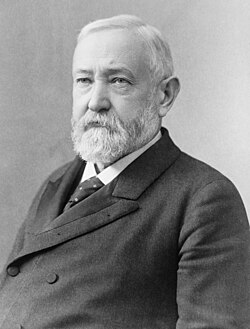
Benjamin Harrison
August 20, 1833 – March 13, 1901
23rd president of the United States (1889-1893), a Union Army veteran and Indiana Republican who won the 1888 election in the Electoral College while losing the popular vote.
Biography
Benjamin Harrison was born in 1833 on a farm at North Bend, Ohio, a grandson of President William Henry Harrison. He studied at Farmer's College near Cincinnati and graduated from Miami University in 1852, read law, and in 1854 moved to Indianapolis, where he built a law practice and became active in the new Republican Party. He was elected city attorney in 1857 and reporter of the Indiana Supreme Court in 1860.
In the Civil War he commanded the 70th Indiana Infantry, fought in the Atlanta campaign, and was made a brevet brigadier general. Afterwards he became one of Indiana's leading lawyers. He lost the 1876 race for governor, but the state legislature sent him to the U.S. Senate, where he served from 1881 to 1887.
In 1888 he defeated President Grover Cleveland, winning the Electoral College while losing the popular vote. His administration passed the Sherman Antitrust Act and the protective McKinley Tariff, admitted six western states, began national forest reserves and rebuilt the navy, but his efforts for federal education aid and Black voting rights failed. High tariffs and spending turned voters against the Republicans, and Cleveland beat him in 1892.
Back in Indianapolis he practised law, lectured, and in 1899 argued Venezuela's case in its boundary dispute with Britain before a tribunal in Paris. He died of complications from influenza in 1901.
Offices held
Grover Cleveland Succeeded by
Grover Cleveland
Military service
Affiliations
Education
- Jan 1, 1850 – Jan 1, 1852 Miami University BA 1852
Party membership
- Republican Party (United States)
- Whig Party (United States) Whig before joining the Republicans in 1856


