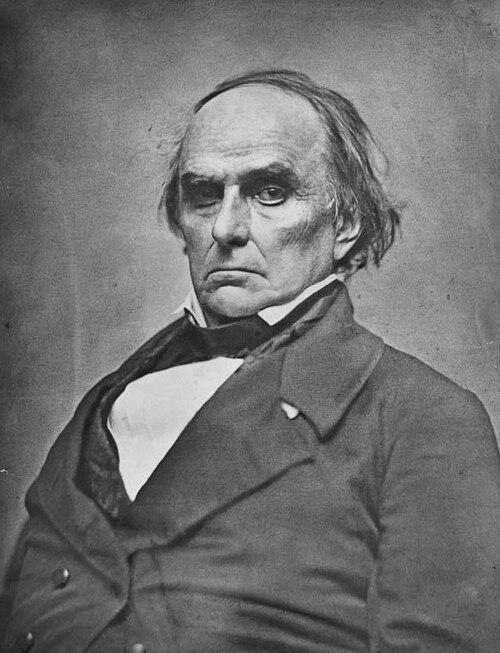
Daniel Webster
January 18, 1782 – October 24, 1852
American lawyer and statesman who argued landmark constitutional cases before the Supreme Court, represented New Hampshire and Massachusetts in Congress and was secretary of state under Harrison, Tyler and Fillmore. With Henry Clay and John C. Calhoun he formed the Senate's 'Great Triumvirate'.
Biography
Daniel Webster was born in 1782 in Salisbury, New Hampshire, the son of a farmer and local official. He attended Phillips Exeter Academy and graduated from Dartmouth College in 1801, read law, clerked in Boston for Christopher Gore and was admitted to the bar in 1805. Practising in Boscawen and then Portsmouth, he became one of New Hampshire's leading lawyers and a prominent Federalist critic of the War of 1812.
He served two terms in the House of Representatives for New Hampshire from 1813 and moved to Boston in 1816. Before the Supreme Court he argued many of the Marshall Court's landmark cases, among them Dartmouth College v. Woodward, McCulloch v. Maryland and Gibbons v. Ogden, and over his career he appeared in more than two hundred cases there. He returned to the House for Massachusetts in 1823 and was elected to the Senate in 1827.
As a National Republican and then Whig leader he fought Andrew Jackson's domestic program. His Second Reply to Hayne in 1830 made the case for a perpetual Union against nullification; he supported Jackson during the nullification crisis but opposed him over the national bank. He ran for president in 1836 and carried only Massachusetts. As secretary of state under Harrison and Tyler from 1841 to 1843 he negotiated the Webster-Ashburton Treaty with Britain.
Back in the Senate from 1845, he led the 'Cotton Whigs'. His Seventh of March speech of 1850 backed Henry Clay's compromise, including a tougher fugitive slave law, and cost him much of his Northern support. Millard Fillmore made him secretary of state again in July 1850. After losing the 1852 Whig nomination, he died at his Marshfield estate in October 1852.
Offices held
2 terms
- Mar 4, 1813 – Mar 3, 1817
- Mar 4, 1823 – May 30, 1827
2 terms
- Jun 8, 1827 – Feb 22, 1841
- Mar 4, 1845 – Jul 22, 1850
Jacob L. Martin Succeeded by
Charles Magill Conrad
2 terms
- Mar 6, 1841 – May 8, 1843 Preceded by Jacob L. Martin Succeeded by Hugh S. Legaré
- Jul 23, 1850 – Oct 24, 1852 Preceded by John M. Clayton Succeeded by Charles Magill Conrad
Affiliations
Education
- Jan 1, 1796 – Jan 1, 1796 Phillips Exeter Academy Attended Phillips Exeter Academy in 1796
- Jan 1, 1797 – Jan 1, 1801 Dartmouth College Dartmouth College, admitted 1797, graduated 1801
Party membership
- Jan 1, 1825 – Jan 1, 1833 National Republican Party Infobox: National Republican 1825-1833
- Jan 1, 1834 – Oct 24, 1852 Whig Party (United States)
- Federalist Party Infobox: Federalist before 1825; end set to the entity's end date (1824) so it stays inside the party's lifetime


