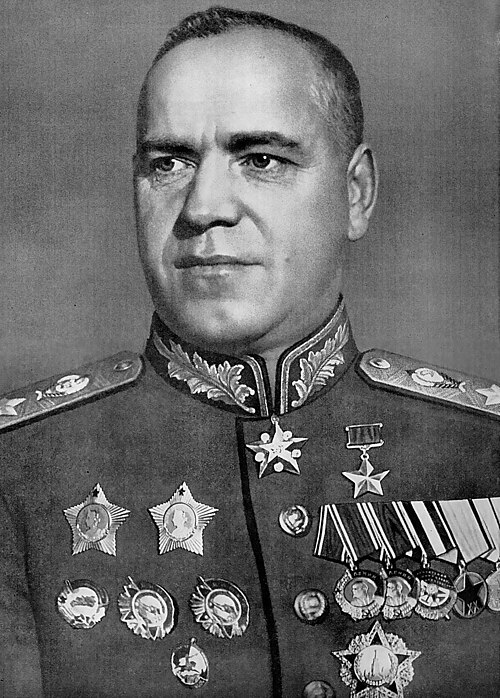
Georgy Zhukov
December 1, 1896 – June 18, 1974
Soviet marshal who led the Red Army's defence of Moscow and Leningrad and its victories at Stalingrad, Kursk and Berlin.
Biography
Georgy Zhukov was born in 1896 into a poor peasant family in Strelkovka, Kaluga Governorate, and was apprenticed as a furrier in Moscow. Conscripted into the Imperial Russian Army in 1915, he served in a dragoon regiment and won the Cross of St. George twice. After the October Revolution he joined the Bolsheviks and fought as a cavalryman in the Russian Civil War, including against the Tambov Rebellion.
Between the wars he rose through cavalry commands and studied at the Frunze Military Academy in 1929–30. In 1939 he led Soviet and Mongolian forces to victory over the Japanese at Khalkhin Gol, earning the first of four Hero of the Soviet Union awards, and in early 1941 Stalin made him chief of the General Staff.
He lost that post soon after the German invasion over a disagreement about the defence of Kiev, but went on to play a leading part at Leningrad, Moscow, Stalingrad and Kursk. Named deputy supreme commander in 1942 and Marshal of the Soviet Union in 1943, he helped plan Operation Bagration and in 1945 led the 1st Belorussian Front into Germany and to Berlin. He accepted the German surrender for the Soviet side and became the first military governor of the Soviet occupation zone.
Seeing him as a rival, Stalin removed him to minor commands after the war. Zhukov backed Nikita Khrushchev after Stalin's death, became Minister of Defence in 1955 and joined the party Presidium, but he was forced out in 1957 and never held high office again. He died in Moscow in 1974.
Military service
- Oct 1, 1918 – Oct 26, 1957 Red Army Red Army / Soviet Armed Forces
- 1st Ukrainian Front
Affiliations
Party membership
- Mar 1, 1919 – Jun 18, 1974 Communist Party of the Soviet Union
Education
- Jan 1, 1929 – Dec 31, 1930 Frunze Military Academy


