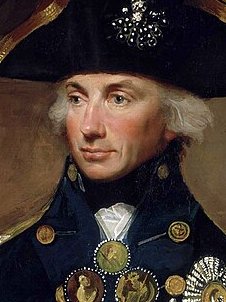
Horatio Nelson
September 29, 1758 – October 21, 1805
British admiral who won the battles of the Nile and Trafalgar against France. He was killed at Trafalgar in 1805.
Biography
Horatio Nelson was born in 1758 at the rectory of Burnham Thorpe, Norfolk, the sixth of eleven children of a clergyman. Through his uncle Maurice Suckling, a senior naval officer, he joined the Royal Navy in 1771. As a teenager he sailed to the West Indies on a merchant ship, served as a coxswain on Constantine Phipps's 1773 Arctic expedition and then went to the East Indies, where he saw his first action and nearly died of malaria.
He passed his lieutenant's examination in 1777, gained his first command in 1778 and served in the Caribbean during the American war, but after peace in 1783 he was put on half pay. The French Revolutionary Wars brought him back to sea in 1793; he took part in the siege of Toulon and the invasion of Corsica, where he lost most of the sight of one eye.
In 1797 he distinguished himself at the Battle of Cape St. Vincent and lost his right arm in the attack on Santa Cruz de Tenerife. The next year he destroyed the French fleet at the Battle of the Nile. His involvement in Neapolitan politics and his affair with Emma Hamilton damaged his standing, but in 1801 he defeated the Danish fleet at Copenhagen.
When war with France resumed in 1803 he commanded the Mediterranean fleet, blockading Toulon and chasing the escaped French and Spanish fleet to the West Indies and back. On 21 October 1805 he engaged the combined fleet off Cape Trafalgar, winning a decisive victory, but was shot by a French marksman aboard HMS Victory and died. He was given a state funeral and buried in St Paul's Cathedral.

