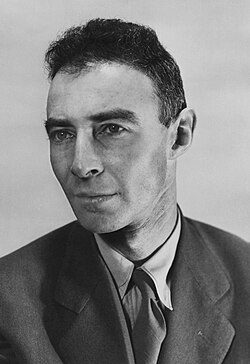
J. Robert Oppenheimer
April 22, 1904 – February 18, 1967
American physicist who directed the Los Alamos laboratory of the Manhattan Project, which built the first atomic bombs.
Biography
J. Robert Oppenheimer was born in New York City in 1904 into a wealthy, non-observant Jewish family and attended the Ethical Culture Society School. He studied chemistry at Harvard, graduating in 1925, then went to Christ's College, Cambridge, and took his doctorate under Max Born at Göttingen in 1927; with Born he published the Born-Oppenheimer approximation, still his most cited work.
After fellowships at Harvard and Caltech he joined the University of California, Berkeley, becoming a full professor in 1936 while also teaching at Caltech. He built a leading school of theoretical physics, contributing to quantum electrodynamics and the theory of cosmic ray showers and, with his students, predicting the gravitational collapse of massive stars.
Recruited to the Manhattan Project in 1942, he was chosen to head its secret weapons laboratory at Los Alamos, New Mexico, and directed it from 1943. The laboratory produced the bomb tested at Trinity on 16 July 1945 and the weapons dropped on Hiroshima and Nagasaki the following month.
In 1947 he became director of the Institute for Advanced Study in Princeton, a post he kept until 1966, and chairman of the Atomic Energy Commission's General Advisory Committee, where he pressed for international arms control and opposed developing the hydrogen bomb. In 1954 an AEC security hearing revoked his clearance, citing his views and his past associations with Communists; the decision was vacated in 2022. He received the Enrico Fermi Award in 1963 and died of throat cancer in Princeton in 1967.
Affiliations
Education
- Jan 1, 1911 – Jan 1, 1921 Ethical Culture Fieldston School Graduated 1921
- Harvard University
- University of Göttingen
- Harvard College
- Christ's College, Cambridge Graduate study at Cambridge after Harvard (accepted 1924)
- University of Cambridge
- Jesus College, Cambridge


