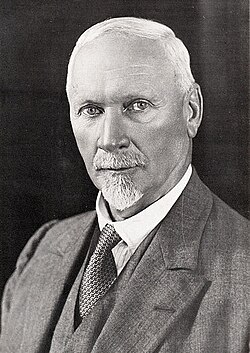
Jan Smuts
May 24, 1870 – September 11, 1950
South African soldier and statesman, Prime Minister in 1919-1924 and 1939-1948 and a British field marshal in both world wars.
Biography
Jan Christiaan Smuts was born in 1870 on a farm near Malmesbury in the Cape Colony to a prosperous Afrikaner family. He studied at Victoria College in Stellenbosch, graduating in 1891, and then read law at Christ's College, Cambridge, on a scholarship, finishing in 1894 with a double first. After qualifying at the Middle Temple he returned to the Cape in 1895, practised law, supported Cecil Rhodes and worked for De Beers, but broke with Rhodes after the Jameson Raid and became state attorney of the South African Republic in Pretoria.
He led the Transvaal delegation at the failed Bloemfontein Conference of 1899 and in the Second Boer War served under Koos de la Rey and led a commando raid deep into the Cape Colony. In 1902 he played a leading part in the talks that produced the Treaty of Vereeniging. With Louis Botha he founded the Het Volk party in 1904, became a minister in the self-governing Transvaal, and helped draft the constitution of the Union of South Africa, formed in 1910, where he held several cabinet posts including defence.
In the First World War he suppressed the Maritz rebellion, took part in the conquest of German South-West Africa and commanded the campaign in German East Africa in 1916. From 1917 he sat in Britain's Imperial War Cabinet; at the Paris Peace Conference he helped design the League of Nations and secured a mandate over South-West Africa. He succeeded Botha as prime minister in 1919, a term that included the Bulhoek massacre of 1921, and lost power in the 1924 election. In opposition he wrote Holism and Evolution, coining the term holism.
Smuts returned to government as deputy prime minister under J. B. M. Hertzog, their parties merging in 1934 as the United Party, and became prime minister again in 1939 when parliament voted to enter the Second World War. He was made a British field marshal in 1941 and in 1945 helped draft the preamble of the United Nations Charter. His defeat by the National Party in the 1948 election opened the way to apartheid; he led the opposition and was chancellor of Cambridge University until his death in 1950.
Offices held
Louis Botha Succeeded by
D. F. Malan
2 terms
- Sep 3, 1919 – Jun 30, 1924 Preceded by Louis Botha Succeeded by J. B. M. Hertzog
- Sep 5, 1939 – Jun 4, 1948 Preceded by J. B. M. Hertzog Succeeded by D. F. Malan
Military service
Affiliations
Education
- Jan 1, 1886 – Jan 1, 1891 Stellenbosch University Victoria College, Stellenbosch (became Stellenbosch University in 1918)
- Jan 1, 1891 – Jan 1, 1894 Christ's College, Cambridge law; double first in 1894
- Jesus College, Cambridge
Employment
- Jan 1, 1895 – Jan 1, 1896 De Beers worked for Rhodes; resigned after the Jameson Raid (1895-96)
Party membership
- May 1, 1904 – Jan 1, 1910 Het Volk co-founder and deputy leader under Louis Botha
- Jan 1, 1934 – Sep 11, 1950 United Party (South Africa) formed in 1934 from Hertzog's and Smuts's parties; member until his death
- South African Party


