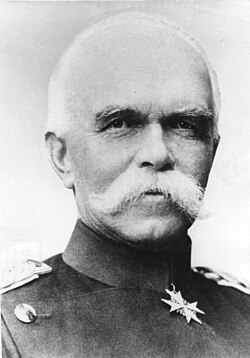
Leo von Caprivi
February 24, 1831 – February 6, 1899
German general and statesman; Chancellor after Bismarck
Biography
Leo von Caprivi was born in 1831 in Charlottenburg, near Berlin, into a Prussian noble family of Italian descent. He joined a Prussian guards regiment in 1849, went through the Prussian Staff College and served on the General Staff. He fought in the wars of 1864 and 1866, and in the Franco-Prussian War he was chief of staff of the X Army Corps, winning the Pour le Mérite.
In 1883 he was placed at the head of the Imperial Admiralty with the rank of vice-admiral. He reorganised the navy and favoured torpedo boats and a defensive fleet, which brought him into conflict with Wilhelm II's wish for a battleship navy, and he resigned in 1888 to return to the army.
When Wilhelm dismissed Bismarck in March 1890, Caprivi became imperial chancellor and Prussian minister-president. His "New Course" let the Reinsurance Treaty with Russia lapse, sought closer ties with Britain through the Heligoland–Zanzibar Treaty, and replaced protectionism with a series of commercial treaties that cut tariffs. At home he tried to reconcile the Centre Party and the Social Democrats, did not renew the Anti-Socialist Laws and backed social legislation.
Agrarian, colonial and conservative opposition, the failure of a denominational school bill and a fight over the army bill wore down his position. He gave up the Prussian premiership in 1892, and in October 1894 the emperor dismissed him as chancellor. He destroyed his papers, withdrew from public life and died in 1899 at Skyren (now Skórzyn in Poland).
Offices held
Otto von Bismarck Succeeded by
Chlodwig, Prince of Hohenlohe-Schillingsfürst
Also Chancellor of 1 other
- German Empire Mar 20, 1890 – Oct 26, 1894
Otto von Bismarck Succeeded by
Botho zu Eulenburg
Military service
Affiliations
Education
- Jan 1, 1854 – Jan 1, 1857 Prussian Military Academy Prussian Staff College (Kriegsakademie); years from Wikidata Q10873


