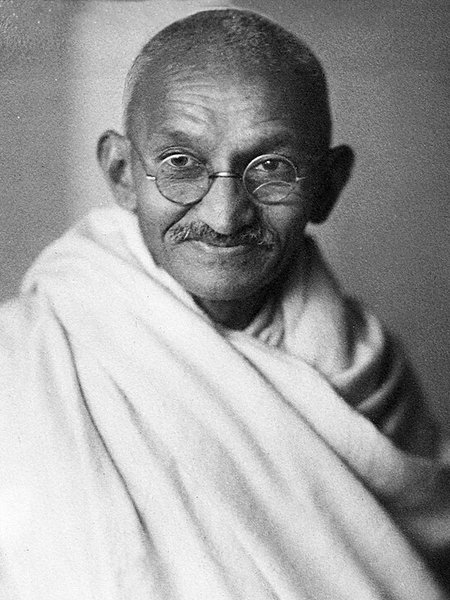
Mahatma Gandhi
October 2, 1869 – January 30, 1948
Mohandas Karamchand Gandhi (1869-1948) was an Indian lawyer, anti-colonial nationalist, and political ethicist who employed nonviolent resistance to lead the campaign for India's independence from British rule. After 21 years in South Africa, where he first used nonviolent resistance in civil rights campaigns, he returned to India in 1915 and assumed leadership of the Indian National Congress in 1921. The honorific Mahatma, meaning "great-souled," was first applied to him in 1914 in South Africa.
Biography
Mohandas Karamchand Gandhi was born in 1869 in Porbandar, in western India. He studied law in London and in 1893 went to South Africa, where he spent two decades leading the Indian community against discrimination. There he developed satyagraha, a method of mass nonviolent resistance.
Back in India from 1915, he became the leading figure of the Indian National Congress. He led a national non-cooperation movement in 1920–22, the Salt March of 1930 against the British salt tax, and the Quit India movement of 1942, and was jailed many times. He also campaigned against untouchability and for Hindu–Muslim unity, and promoted village self-reliance and homespun cloth.
India became independent in August 1947, but it was partitioned, and millions were killed or displaced in communal violence. Gandhi fasted to stop the killing in Calcutta and Delhi. On 30 January 1948 he was shot dead in Delhi by a Hindu nationalist. In India he is called the Father of the Nation.
Offices held
Affiliations
Education
- from Jan 1, 1888 University College London
Party membership
- Jan 1, 1915 – Oct 31, 1934 Indian National Congress Joined on returning to India from South Africa; resigned membership October 1934


