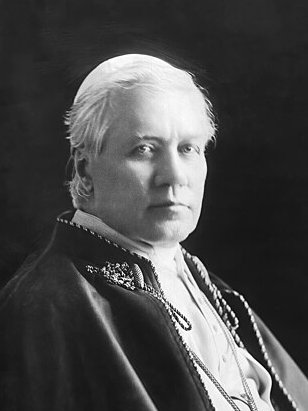
Pius X
June 2, 1835 – August 20, 1914
Italian pope from 1903 to 1914, known for his campaign against modernism.
Biography
Giuseppe Melchiorre Sarto was born in 1835 in Riese, then in the Austrian Empire, to a poor family. A scholarship took him to the seminary of Padua, and he was ordained a priest in 1858. He served as a parish priest, then as archpriest of Salzano and chancellor of the diocese of Treviso, where he also taught theology at the seminary.
He was made bishop of Mantua in 1884 and in 1893 became a cardinal and patriarch of Venice. The conclave that followed the death of Leo XIII elected him pope on 4 August 1903, and he took the name Pius X.
As pope he opposed modernist readings of Catholic doctrine, which he condemned as a synthesis of all heresies, and promoted Thomist theology. He encouraged frequent communion and lowered the age of first communion, pushed liturgical and church-music reform, reorganised the Roman Curia in 1908, and began the work that produced the 1917 Code of Canon Law. After the 1908 Messina earthquake he housed refugees in the Apostolic Palace.
He was known for his personal simplicity and refused favours for his relatives. He died in August 1914, weeks after the First World War began, and was canonised in 1954.
