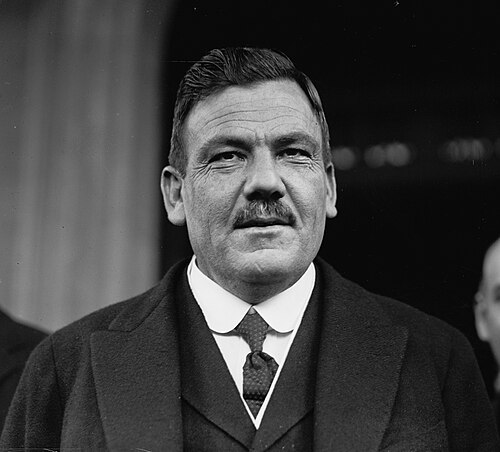
Plutarco Elías Calles
September 25, 1877 – October 19, 1945
Mexican revolutionary general who was President from 1924 to 1928, founded the ruling party in 1929 and dominated politics as 'Jefe Máximo' until 1935.
Biography
Plutarco Elías Calles was born in Guaymas, Sonora, in 1877 to unmarried parents and was raised by an uncle whose firm secularism shaped his later hostility to the Catholic Church. As a young man he worked as a schoolteacher, a bartender and in other jobs. He backed Francisco Madero in the revolution, serving as a police commissioner, and then rose quickly in Venustiano Carranza's Constitutionalist Army, becoming a general by 1915 and defending Sonora against Pancho Villa's forces at Agua Prieta.
He governed Sonora from 1915 to 1919, promoting prohibition, education and labour laws, and then joined Carranza's cabinet as secretary of industry, commerce and labour. In 1920 he joined fellow Sonorans Álvaro Obregón and Adolfo de la Huerta in the Plan of Agua Prieta, which overthrew Carranza; he became minister of war under de la Huerta and secretary of the interior under Obregón. With the support of Obregón and the CROM labour federation he won the 1924 presidential election with 84 percent of the vote.
As president from 1924 to 1928 he expanded rural schooling, began a national road network, created a cabinet-level public health post, oversaw the founding of the Banco de México and gave illegitimate children equal civil rights. His strict enforcement of the constitution's anticlerical articles through the 1926 Calles Law led to the Cristero War. After President-elect Obregón was assassinated in 1928, Calles founded the National Revolutionary Party in 1929, the forerunner of today's Institutional Revolutionary Party.
From 1928 to 1934, the period known as the Maximato, he dominated politics as the Jefe Máximo behind three short-lived presidents and held cabinet posts himself. He backed Lázaro Cárdenas for president in 1934, but Cárdenas turned against him and deported him to the United States in April 1936. Allowed back in 1941, he lived quietly in Mexico City and Cuernavaca and died in 1945; he is buried in the Monument to the Revolution.
Offices held
Military service
Affiliations
Party membership
- from Mar 4, 1929 Institutional Revolutionary Party
- Laborist Party (Mexico) infobox: Laborist Party until 1929; its candidate in 1924

