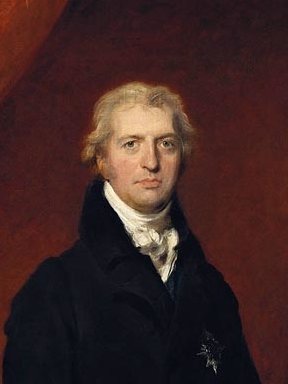
Robert Jenkinson, 2nd Earl of Liverpool
June 7, 1770 – December 4, 1828
British Tory statesman; Prime Minister 1812-1827
Biography
Robert Banks Jenkinson was born in London in 1770, the son of the Tory politician Charles Jenkinson, later the first Earl of Liverpool; his mother died a month after his birth. He was educated at Charterhouse and at Christ Church, Oxford, where he began a lifelong friendship with George Canning, and he was in Paris when the Bastille was stormed in 1789. Elected for Rye in 1790, he took his seat in 1791 and soon made his name as a government speaker, joining the India Board in 1793 and becoming a privy councillor and master of the Mint in 1799.
As Lord Hawkesbury he entered the cabinet in 1801 as foreign secretary under Henry Addington and handled the negotiations that produced the Treaty of Amiens. Raised to the House of Lords in 1803, he led the government there and served as home secretary under Pitt and again under the Duke of Portland. He succeeded his father as earl in 1808 and in 1809 became secretary of state for war and the colonies, making sure the cabinet backed the Peninsular campaign.
After Spencer Perceval was assassinated in 1812, Liverpool became prime minister and held the office for almost fifteen years. His government saw Britain through the War of 1812 and the final defeat of Napoleon, then faced a troubled peace marked by the Corn Law of 1815, the repeal of income tax against his wishes, riots, the Peterloo Massacre and the Six Acts, the Cato Street plot to kill the cabinet, and the failed attempt in 1820 to strip Queen Caroline of her title. From 1822, with Peel, Canning and Huskisson in office, the ministry turned to liberal reforms of trade, prisons and the criminal law.
A stroke in February 1827 ended his career, and he died at Kingston upon Thames in December 1828. Little admired in the nineteenth century, he has since been credited by historians with holding together a divided party and giving Britain stable government through war and its aftermath; no later prime minister has served longer.
Offices held
Charles Philip Yorke Succeeded by
Richard Ryder
2 terms
- May 12, 1804 – Feb 5, 1806 Preceded by Charles Philip Yorke Succeeded by George Spencer, 2nd Earl Spencer
- Mar 25, 1807 – Nov 1, 1809 Preceded by George Spencer, 2nd Earl Spencer Succeeded by Richard Ryder
Spencer Perceval Succeeded by
George Canning
Affiliations
Education
- Apr 1, 1787 – May 1, 1790 Christ Church, Oxford Christ Church, Oxford: entered April 1787, MA May 1790
- Charterhouse School Boarder from age thirteen until he went up to Oxford in April 1787


