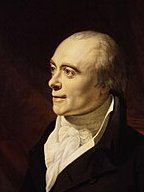
Spencer Perceval
November 1, 1762 – May 11, 1812
19th-century prime minister of the United Kingdom (1762–1812)
Biography
Spencer Perceval was born in Mayfair in 1762, a younger son of the 2nd Earl of Egmont, and was educated at Harrow and Trinity College, Cambridge. With little family money, he studied at Lincoln's Inn, was called to the bar in 1786 and practised on the Midland Circuit, becoming a King's Counsel in 1796. That year he entered Parliament for Northampton, a seat he held until his death.
A follower of William Pitt the Younger and an evangelical Anglican, Perceval opposed Catholic emancipation and parliamentary reform but supported the abolition of the slave trade. He was Solicitor General and then Attorney General under Henry Addington, and in opposition in 1806 he defended Princess Caroline in the 'delicate investigation' into her conduct. In 1807 the Duke of Portland made him Chancellor of the Exchequer and Leader of the House of Commons.
Perceval became prime minister in October 1809, keeping the Exchequer himself. His weak government faced the Walcheren inquiry, the final illness of George III and the Regency, economic depression and Luddite unrest, but it kept up the war in the Peninsula and won the Prince Regent's backing. On 11 May 1812 he was shot dead in the lobby of the House of Commons by John Bellingham, a merchant with a grievance against the government; he remains the only British prime minister to have been assassinated.
Offices held
Henry Petty-Fitzmaurice, 3rd Marquess of Lansdowne Succeeded by
Nicholas Vansittart, 1st Baron Bexley
Edward Smith-Stanley, 12th Earl of Derby Succeeded by
Robert Hobart, 4th Earl of Buckinghamshire
William Cavendish-Bentinck, 3rd Duke of Portland Succeeded by
Robert Jenkinson, 2nd Earl of Liverpool
Affiliations
Party membership
Education
- Harrow School Harrow School
- Trinity College, Cambridge Trinity College, Cambridge
- Lincoln's Inn legal training; called to the bar 1786

