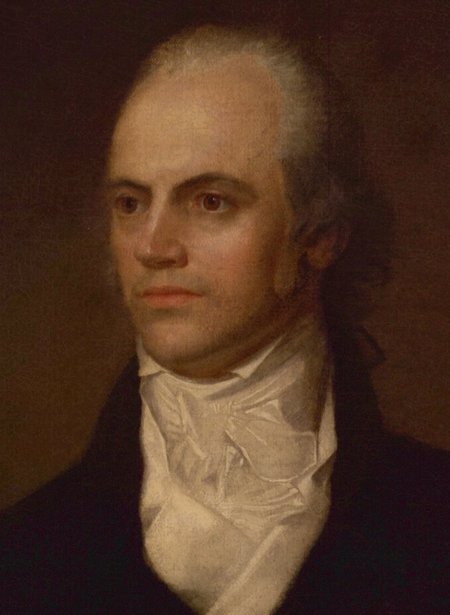
Aaron Burr
February 6, 1756 – September 14, 1836
American lawyer and politician who was the third vice president of the United States (1801–1805). He killed Alexander Hamilton in an 1804 duel and was later tried and acquitted of treason over the Burr conspiracy.
Biography
Aaron Burr was born in Newark, New Jersey, in 1756, the son of a Presbyterian minister who presided over the College of New Jersey and grandson of the theologian Jonathan Edwards. Orphaned as a small child, he graduated from the College of New Jersey (now Princeton) in 1772, studied theology and then law, and in 1775 joined the Continental Army. He took part in Benedict Arnold's march on Quebec and served until 1779, rising to lieutenant colonel.
After the war Burr practised law in New York City and became a leading figure in its politics. He sat in the state assembly, was New York's attorney general from 1789 to 1791, and represented the state in the US Senate from 1791 to 1797. In 1799 he founded the Manhattan Company, a bank that also served Democratic-Republican interests, and in 1800 he helped deliver New York to Thomas Jefferson. A tie in the electoral vote between Burr and Jefferson sent the 1800 election to the House, which chose Jefferson; Burr became vice president.
Sidelined by Jefferson, Burr presided as vice president over the Senate trial of Justice Samuel Chase. In 1804 he lost the race for governor of New York and killed Alexander Hamilton in a duel at Weehawken. After leaving office he travelled in the western territories, and in 1807 he was arrested and tried for treason over an alleged plan to set up an independent state in the West or in Spanish lands; he was acquitted. He spent several years in Europe, returned to legal practice in New York in 1812, and died on Staten Island in 1836.
Offices held
Thomas Jefferson Succeeded by
George Clinton
Military service
Affiliations
Education
- Jan 1, 1769 – Jan 1, 1772 Princeton University College of New Jersey (now Princeton), AB 1772
- Litchfield Law School


