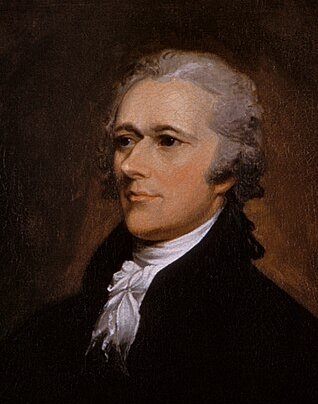
Alexander Hamilton
January 11, 1755 – July 12, 1804
American Founding Father who was the first U.S. secretary of the treasury (1789-1795) and a leader of the Federalist Party. He was killed in a duel with Aaron Burr in 1804.
Biography
Alexander Hamilton was born out of wedlock in Charlestown on Nevis in the Caribbean, in 1755 or 1757, and was orphaned as a child. Taken in by a merchant and later given a scholarship, he entered King's College in New York, now Columbia University, in 1773, where he wrote widely read pamphlets for the patriot cause. In the Revolutionary War he served as an artillery officer, spent four years as an aide-de-camp to George Washington and fought at Yorktown.
After the war he sat in the Congress of the Confederation for New York, practised law and in 1784 founded the Bank of New York. He led the Annapolis Convention of 1786, was a delegate to the Constitutional Convention in 1787 and wrote 51 of the 85 essays of The Federalist in support of ratification. As the first secretary of the treasury from 1789 to 1795 he had the federal government take on the states' war debts, created the First Bank of the United States and the Revenue Cutter Service, and backed the Jay Treaty with Britain. His supporters formed the Federalist Party, against Thomas Jefferson's Democratic-Republicans.
In 1797 he publicly admitted an affair with Maria Reynolds to rebut charges of financial corruption. During the Quasi-War with France President John Adams made him a major general, but he later broke with Adams and in 1800 backed Jefferson over Aaron Burr. In 1801 he founded the New York Evening Post. After he opposed Burr's 1804 run for governor of New York, Burr challenged him to a duel at Weehawken, New Jersey, on 11 July 1804; Hamilton was mortally wounded and died the next day.
Offices held
Military service
Affiliations
Education
- from Jan 1, 1773 Columbia University King's College (now Columbia)
Party membership
Family
Alexander Hamilton