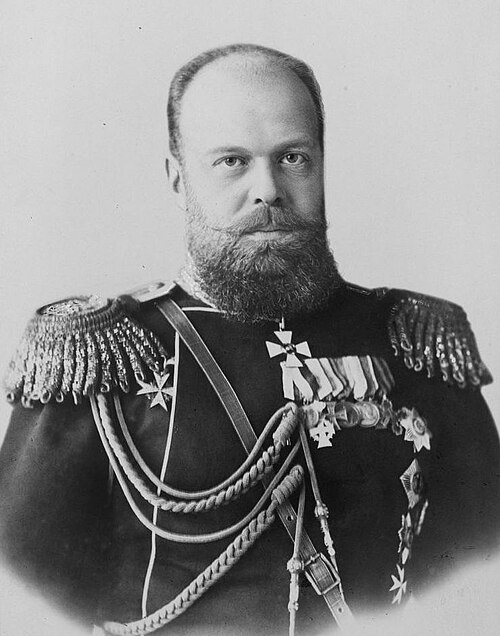
Alexander III of Russia
March 10, 1845 – November 1, 1894
Emperor of Russia from 1881 to 1894, whose reign reversed many of his father's reforms.
Biography
Alexander Alexandrovich was born at the Winter Palace in Saint Petersburg in 1845, the second son of the future Alexander II. As a younger son he received only the ordinary training of a grand duke, but the sudden death of his elder brother Nicholas in 1865 made him heir. He then studied law and administration under Konstantin Pobedonostsev, who shaped his belief in Orthodoxy and autocracy, and in 1866 he married his brother's fiancée, Princess Dagmar of Denmark, who took the name Maria Feodorovna.
He became emperor on 13 March 1881 after his father was assassinated. Reversing much of his father's liberal reform, he pursued what became known as counter-reforms, promoted Russification of the empire's peoples and approved restrictive laws against Jews that fed anti-Jewish feeling and dozens of pogroms. The secret police broke up a plot against him in 1887, and its leaders, including Lenin's elder brother Aleksandr Ulyanov, were hanged.
Russia fought no major war in his reign, earning him the name "the Peacemaker". His main foreign-policy achievement was the alliance with France, and construction of the Trans-Siberian Railway began under him. In 1888 he and his family survived the derailment of the imperial train at Borki. He fell ill with kidney disease and died at Livadia in Crimea in 1894, and was succeeded by his son Nicholas II.
Offices held
Alexander II of Russia Succeeded by
Nicholas II of Russia
Alexander II of Russia Succeeded by
Nicholas II of Russia
Family
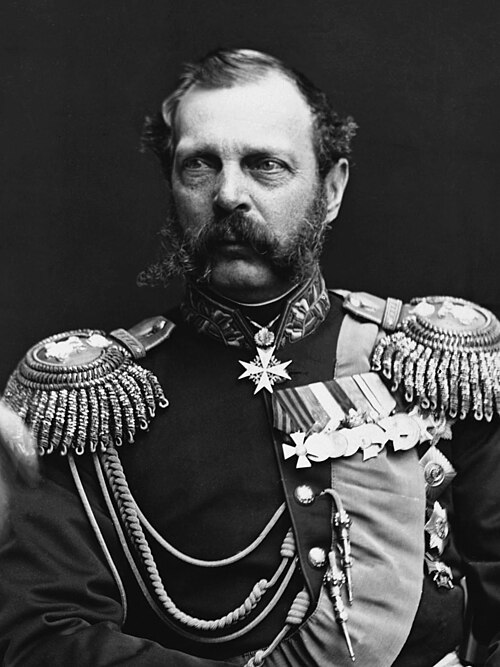
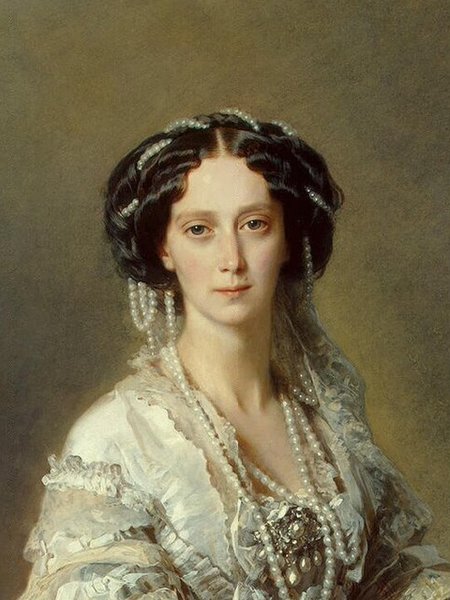 Alexander III of Russia
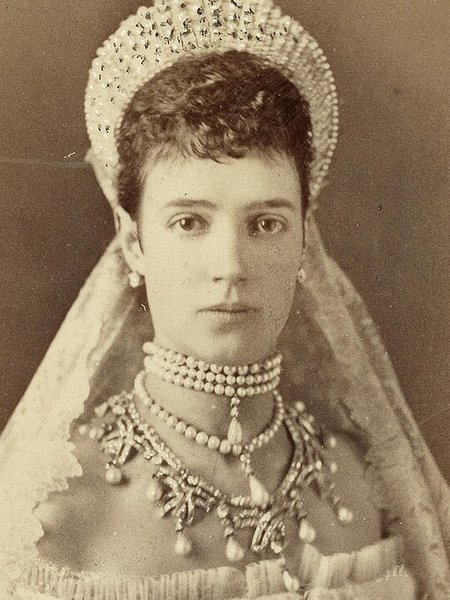 Maria Feodorovna (Dagmar of Denmark)