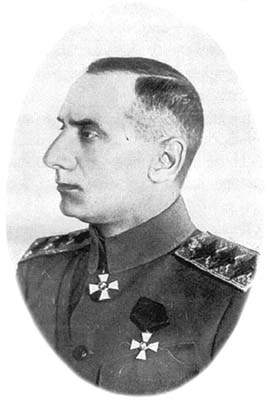
Alexander Kolchak
November 16, 1874 – February 7, 1920
Imperial Russian admiral and polar explorer; 'Supreme Ruler of Russia' heading the White government at Omsk, November 1918 - January 1920. Captured and executed at Irkutsk.
Biography
Alexander Kolchak was born in Saint Petersburg in 1874, the son of a naval artillery officer. He graduated with honours from the Naval Cadet Corps in 1894 and served in the Baltic and the Pacific, publishing work on hydrology. From 1900 to 1902 he was hydrographer on Baron Eduard von Toll's polar expedition aboard the Zarya, surveying the Taymyr Peninsula and the New Siberian Islands, and he later searched for Toll's lost party, winning the Russian Geographical Society's Constantine Medal.
In the Russo-Japanese War he commanded a destroyer and then a coastal battery at Port Arthur, where he was wounded and taken prisoner. Back in Saint Petersburg he worked on the Naval General Staff to rebuild the fleet, helped design the icebreakers Taimyr and Vaigach and commanded Vaigach on an Arctic survey voyage; his study of the ice of the Kara and Siberian seas became a standard work.
In the First World War he organised minelaying in the Baltic and in 1916 became the navy's youngest vice-admiral and commander of the Black Sea Fleet. Removed after the February Revolution, he was sent abroad as a military observer. In November 1918 he became minister of war and navy in the Provisional All-Russian Government at Omsk and, after a coup two weeks later, Supreme Ruler of Russia, heading a military dictatorship that the other White leaders recognised.
His armies advanced in early 1919 but then fell back, and Omsk was lost to the Red Army in November. In January 1920 the Czechoslovak Legion and the Allied mission handed him to the Socialist-Revolutionaries in Irkutsk, and the Bolsheviks shot him there on 7 February 1920.
Offices held
Military service
Affiliations
Party membership
- Jan 1, 1918 – Feb 7, 1920 Whites


