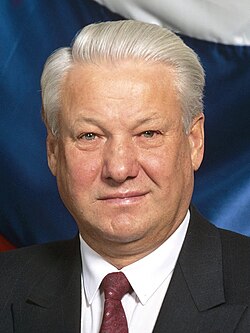
Boris Yeltsin
February 1, 1931 – April 23, 2007
Boris Nikolayevich Yeltsin (1931–2007) was a Soviet and Russian politician who served as President of Russia from 1991 to 1999, having previously served as Chairman of the Supreme Soviet of the Russian SFSR from 1990 to 1991. He was a member of the Communist Party of the Soviet Union from 1961 to 1990, then stood as a political independent aligned with liberalism.
Biography
Boris Yeltsin trained as a construction engineer and rose through the Communist Party in Sverdlovsk. Mikhail Gorbachev brought him to Moscow in 1985 as city party chief, but he was dismissed in 1987 after attacking the slow pace of reform.
He made a comeback as a populist reformer, was elected chairman of the Russian parliament in 1990 and became Russia's first popularly elected president in June 1991. In August 1991 he stood on a tank outside the Russian parliament to rally resistance to the coup against Gorbachev. In December he joined the leaders of Ukraine and Belarus in dissolving the Soviet Union.
His presidency brought rapid privatisation, economic collapse, the shelling of parliament in 1993 and the First Chechen War. He was re-elected in 1996 and resigned on the last day of 1999, naming Vladimir Putin as acting president. He died in 2007.
Offices held
Alexander Kerensky Succeeded by
Egor Gajdar
Affiliations
Party membership
- Jan 1, 1961 – Jul 12, 1990 Communist Party of the Soviet Union


_(cropped).jpg)